Care gaps cost patients more than we think: Why medical affairs needs a faster way to act
Key takeaways
- Care gaps often start with fragmented signals. A lack of integrated data and unclear guidance can prevent teams from seeing where care is drifting from guideline-informed expectations.
- Finding care gaps too late affects patients and strategy. Patients may spend longer with worsening symptoms, while medical affairs teams struggle to focus engagement where it can make the greatest difference.
- Agentic AI helps resolve the disconnect between signals, action and impact. By continuously sensing and connecting evidence, field insights and scientific context, teams can act sooner, focus on the highest-impact gaps and measure whether care patterns improve over time.
How medical affairs can connect evidence, action and better patient care
A patient with rheumatoid arthritis can spend months waiting for treatment changes, a specialist referral and a second opinion while symptoms continue to worsen.
Joint pain, fatigue and morning stiffness begin to dictate her days, forcing her to miss work, skip family activities and plan around what her body can tolerate.
Each step was clinically reasonable on its own. Her primary care team was responsive, and the specialist was thorough. But one part was different. Her treatment was stepped up to stronger, guideline-informed therapy later than it should have been. That kind of delay often comes down to whether the latest evidence, and a clear view of her changing condition, reached her clinician in time to act.
The evidence-side signals were there, across prescribing, referral timing, diagnostics and how her therapy changed over time, but they did not come together soon enough to inform escalation while it still mattered. By the time the pattern was clear, her condition had worsened: more pain, more functional limitation, greater fatigue and an increased risk of irreversible joint damage.
This kind of delay is not isolated. According to the 2026 ZS Medical Affairs Outlook Report, 37% of KOLs cited delays in receiving critical updates about therapies as a challenge in providing the best treatment to patients. When those updates arrive after referral, reassessment or treatment decisions are already underway, patients lose critical treatment time.
That’s what makes care gaps so costly. They are often the accumulated effect of fragmented signals and missed moments to intervene, allowing recommended care to arrive later than expected and leaving patients to carry the consequences long after the delay is recognized.
To close those gaps faster, medical affairs teams first need to understand where and how the signals appear.
How care gaps are found today
Care gap signals often sit across claims, prescription data, real-world evidence, diagnostics, referral patterns and medical affairs insights. Each source shows part of the journey; together, they can reveal where care is drifting from guideline-informed expectations.
But those signals are often reviewed separately. Claims may reveal delayed treatment initiation, while field insights, advisory boards and congress discussions point to uncertainty around escalation or emerging evidence. Without a connected view, teams may see the pieces without seeing the pattern.
When teams often depend on one-off studies, periodic reporting cycles or manual synthesis for care gap analysis, by the time a unified picture emerges, the care pattern may have already moved forward. The patient may have progressed. The decision point may have passed.
That is where care gaps begin to take shape. Not from a single missed signal, but from a disconnected view of the patient journey.
The cost of finding care gaps too late
When care gaps remain hidden, the cost shows up in three ways:
- Patients stay longer in the wrong pathway. The longer the pattern takes to recognize, the more time symptoms have to intensify and the harder it can become to recover the ground already lost.
- Scientific effort spreads too thin. Without one clear view of where the gap is largest, which clinicians sit closest to the decision and where engagement could make the most difference, every signal can look equally urgent, and focus scatters.
- Impact remains difficult to prove. When a gap is found through a one-time analysis, teams know where things stood at that moment, but not whether the gap is closing, widening or shifting somewhere else along the journey. Without a starting baseline, there is nothing to measure improvement against.
Closing gaps sooner also shapes how patients experience their care. When those interactions are guided by a connected view of the gap, teams are better placed to address the right barrier at the right time.
How leading organizations close care gaps
Organizations that close care gaps sooner do not treat care gap analysis as a periodic study. They run it as a repeatable loop, using one consistent framework to refresh the view as new data lands and to keep faster-moving field and scientific signals connected in between.
Continuous does not mean the data updates daily. Claims and other real-world data still arrive with a known lag.
What changes is how the data is used. Instead of starting a new bespoke analysis each time, teams run every refresh through the same framework, using AI to see emerging patterns in both diagnosed and undiagnosed patients, so the picture stays current relative to the data available, and emerging field signals fill the space between refreshes.
FIGURE: Closing the care gap loop has four connected actions.
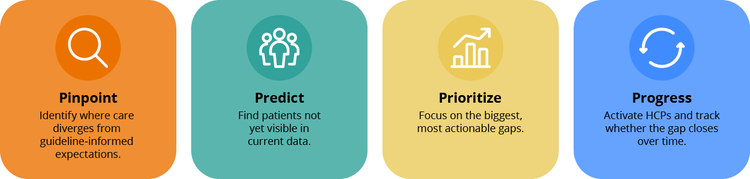
Pinpoint where care diverges from guideline-informed expectations. That could mean delayed diagnosis, later-than-expected treatment initiation, poor persistence, missed monitoring or another point in the journey where the patient’s path begins to drift.
Predict means finding the patients the current data does not yet reveal. By analyzing patterns across the patient population, teams can estimate where patients are likely undiagnosed, underdiagnosed or misdiagnosed, and therefore missing from the visible picture. That shows the true size of unmet need.
Prioritize gaps by size, concentration and actionability. Not every signal deserves the same level of attention. A defensible prioritization process helps teams focus on the patient populations, geographies and HCP segments where the care gap is greatest and where engagement has the highest potential to change outcomes.
Progress means connecting insights to the HCPs who can act and tracking whether the gap closes over time. Instead of measuring only activity, teams can begin to see whether focused scientific exchange, evidence translation or patient support is helping more patients reach recommended care sooner.
For the patient waiting on a treatment change, a loop like this changes what teams can see. The issue is no longer one referral delay or a single decision. It becomes a measurable pattern, symptoms persisting and escalation running late, with a clear opening for earlier scientific exchange before the next patient loses the same time.
How AI in medical affairs helps close care gaps
AI helps medical affairs move from retrospective care gap analysis to repeatable, evidence-based action. By applying a consistent framework as data refreshes and field signals emerge, teams can prioritize the gaps with the greatest patient impact, focus scientific engagement where it is most likely to matter and track whether care patterns improve against a clear baseline.
ZAIDYN Medical Care Gap Intelligence is designed to support that shift by helping teams operationalize care gap intelligence: surfacing where care is diverging, clarifying likely drivers, focusing engagement on the HCPs and patient populations where it may matter most and tracking whether the pattern changes over time.
The goal is not to replace clinical judgment. It is to make the care gap visible sooner, make scientific exchange more relevant and help teams understand whether their engagement is changing the care pattern that matters most. For the next patient, that could mean earlier escalation, fewer months of uncontrolled inflammation and more time protected from avoidable decline.
Related resources



See ZAIDYN in action
