Scientific adoption in medical affairs: What drives impact
Moving beyond scaling scientific activity to driving scientific adoption
Medical affairs teams are operating in a landscape with rising scientific complexity, faster information flow and greater expectations to demonstrate value across therapy areas and regions.
In this environment, many leaders are noticing a dynamic: activity is increasing, but scientific adoption isn’t scaling proportionally.
A key reason is that the industry often conflates two different constructs:
- Scientific presence: the volume of scientific activity—publications, congress activity, field interactions, content and engagement
- Scientific adoption: the degree to which scientific evidence is understood, reinforced and acted on by the broader scientific and clinical ecosystem
FIGURE 1: Scientific presence versus scientific adoption
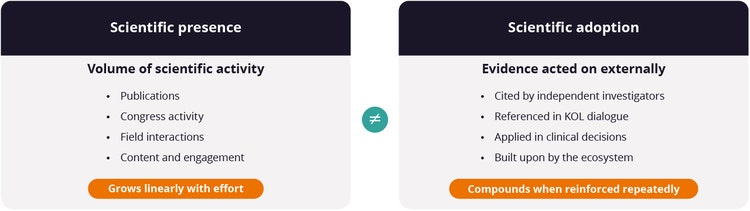
This distinction matters because presence is now scaling faster than ever. AI is accelerating publication timelines, multiplying content formats and expanding the channels through which evidence reaches the ecosystem. Presence can grow exponentially. But adoption does not follow automatically. It compounds only when the ecosystem repeatedly reuses, strengthens and builds upon the evidence over time.
So the question becomes: what does it take for medical affairs to scale scientific adoption, not just scale activity?
Why scientific adoption doesn’t automatically scale with activity
Medical affairs does not have an effort problem. In most organizations, the challenge is the underlying infrastructure that supports how the organization detects, prioritizes, reinforces and learns from the external environment.
Below are four common constraints that present even when teams are highly capable and productive.
1. Signals are detected, but not continuously interpreted
Medical affairs teams capture a significant volume of external signals through field interactions, congresses, publications, advisory boards and digital channels.
But these signals are often episodic and fragmented. They are reviewed in cycles rather than continuously and rarely synthesized into a real-time view of how scientific understanding is evolving externally.
As a result, teams may miss early indications of how evidence is being interpreted, questioned or misapplied. By the time a pattern is spotted, the window to reinforce the right scientific narrative at the right time has often already passed.
2. Priorities are defined, but not consistently reinforced
Organizations typically invest significant effort in defining evidence priorities and scientific narratives. However, these priorities often fragment as they move into execution across regions, teams and channels.
Different stakeholders emphasize different aspects of the data. Scientific messaging evolves independently. Reinforcement becomes inconsistent.
Over time, these mixed signals weaken the cumulative effect of the evidence in the external ecosystem. The science exists. The consistent signal does not.
3. Channels are active, but reinforcement is not intentional
Medical affairs engages through multiple channels: medical service liaisons (MSLs), publications, congresses, digital platforms and expert engagements. While each channel may be effective individually, they are rarely orchestrated around a shared objective: reinforcing a consistent scientific understanding over time.
Instead, activities are planned and executed independently, without a clear, coordinated view of how they collectively build toward scientific adoption. The organization is present across every channel. The narrative does not travel consistently across any of them.
4. Measurement focuses on activity, not scientific adoption
Most organizations track what they can easily measure: number of interactions, publications, reach and engagement metrics. While important, these indicators primarily reflect activity, not whether scientific evidence is being understood, trusted and applied in practice.
Feedback loops are often weak, and teams cannot clearly see which efforts are driving adoption and where reinforcement is needed. The signals that would tell them include:
- Citation trajectory and downstream referencing by independent investigators
- Recurrence of perspectives in congress discussions and key opinion leader (KOL) dialogue
- Shifts in how healthcare providers (HCPs) frame questions and objections
- Spread of a scientific perspective beyond initial KOLs into the broader network
- Changes in clinical practice, including treatment decisions, guideline adoption and protocol updates that reflect the evidence being applied in day-to-day care
The goal is not a perfect measurement. It is enough visibility to double down on what is gaining traction and refine what is not.
FIGURE 2: What happens today versus what should happen
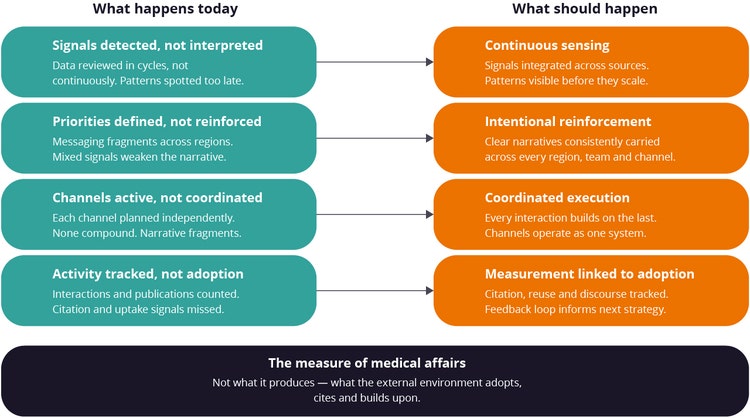
Moving from activity to scientific adoption: A connected system
Addressing these constraints requires more than incremental improvement. It requires a shift in how medical affairs operates across the entire evidence-to-engagement life cycle.
Four capabilities become critical.
1. Continuous sensing of scientific understanding
Organizations need to move from periodic insight generation to continuous sensing of how evidence is being interpreted across the ecosystem. This means bringing signals together across sources, detecting emerging patterns early and making them visible in a way that drives action, not just reporting.
2. Intentional reinforcement of scientific priorities
Scientific priorities must be translated into clear, repeatable narratives that are consistently reinforced across regions, teams and channels. This is not about more content. It is about making sure every interaction strengthens the same core scientific understanding over time. Consistent reinforcement is what turns a credible perspective into a widely held one.
3. Coordinated execution across channels
Channels must be orchestrated as a system, not managed independently. Each interaction, whether through an MSL conversation, a publication or a congress presentation, should reinforce prior touch points and contribute to building cumulative understanding. When channels are coordinated, every interaction adds to the last. When they are not, none of them compound.
4. Measurement linked to adoption and learning
Organizations need to complement activity metrics with indicators of adoption: how evidence is being cited, referenced, trusted and applied. This creates a feedback loop that allows teams to refine strategies based on what is actually resonating in the external environment, rather than what was planned internally.
The role of a connected system
The common thread across these capabilities is the need for a connected system—one that links sensing, prioritization, execution and learning.
FIGURE 3: The connected system
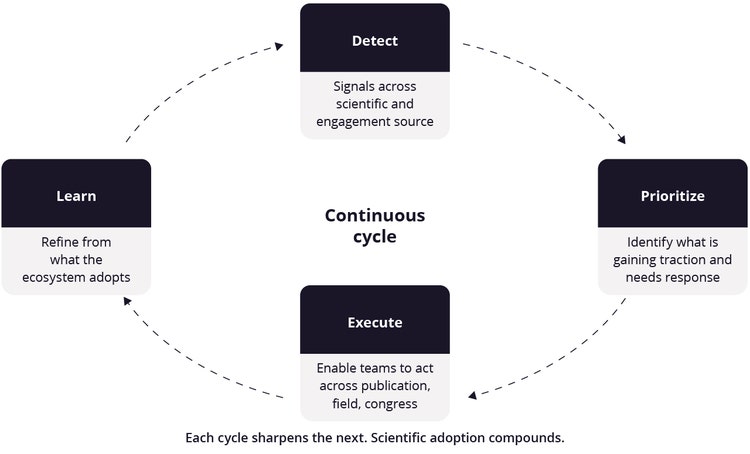
In a connected system, each stage feeds the next continuously. Detection informs prioritization. Prioritization shapes execution. Execution generates signals that feed back into detection. The cycle does not stop, and it does not require a planning review to restart.
This is what enables scientific adoption to compound.
Making scientific adoption the true measure of impact
Medical affairs has never been more active or more scientifically productive.
But in today’s environment, activity alone is not a proxy for impact.
Impact is reflected in whether scientific evidence is:
- Understood consistently
- Reinforced over time
- Trusted by the ecosystem
- Applied in clinical and healthcare decision-making
This is scientific adoption.
In the end, what scientific impact actually looks like is not what medical affairs produces, but instead what the external environment adopts. And that adoption only scales through a system that continuously senses, prioritizes, reinforces and learns, enabling organizations to shape the scientific narrative rather than react to it.
To explore how this approach can be applied in practice, you can learn more about ZAIDYN Medical or request a tailored demonstration.
Related resources



See ZAIDYN in action
