Digital opinion leaders in medical affairs: Who they are and why they matter
Key takeaways
• Digital opinion leaders (DOLs) act as amplifiers of scientific exchange, extending the reach of credible clinical perspectives across digital conversations and peer networks.
• DOLs are not less senior or less credible than traditional key opinion leaders (KOLs). Many are established experts who have intentionally built meaningful influence through digital channels.
• For midsize and emerging pharma companies, DOL engagement can create a more scalable path to scientific share of voice by extending credible scientific exchange beyond the limits of field coverage alone.
• Identifying and engaging DOLs requires a structured approach that evaluates relevance, reach, resonance and scientific credibility, supported by opinion leader intelligence that connects traditional and digital influence in one view.
The rise of Digital Opinion Leaders (DOLs)
Medical affairs teams have long relied on KOLs to both understand the scientific landscape and shape it. By engaging and educating these experts, teams ensure current evidence travels further and ultimately support better patient care.
The model is sound and has served the field well as it’s built on credible markers of scientific standing.
But on its own it is no longer enough, because scientific conversation is expanding beyond the formal channels medical affairs has traditionally measured. The same digital shift that reshaped how audiences everywhere form opinions has reached science, and it has extended how far a credible voice can travel.
While influence is still visible in journals, congress halls and trial leadership, it is also forming in digital spaces where clinicians, researchers and scientific communities interpret evidence in real time. In fact, 60% of healthcare professionals (HCPs) reported changing their perception of a medication based on content from digitally active peers and opinion leaders, and 50% reported changing a prescription as a result.
As the traditional KOL list is often a snapshot, built through periodic research, manual validation and internal review, the process captures a moment in time rather than the current state of the scientific conversation. By the time the list is refreshed, the conversation may have shifted, new questions may have emerged, and different voices may have shaped how evidence is understood.
That matters because the outcomes medical affairs is measured on, such as scientific adoption and HCP trust, depend on being present where evidence is being interpreted. A method that misses that space ultimately limits the impact the team set out to create.
To close that gap, it helps to be precise about what digital influence actually is. It is not just a communications layer on top of traditional scientific exchange. It changes the speed, scale and visibility of the conversation. A perspective shared by a credible, digitally active expert can move across professional networks within hours, reaching peers who would never have been in the room for a single congress session, advisory board or field interaction.
So, as digital influence is shaping how far a perspective travels, who are the experts driving it?
Who Digital Opinion Leaders are
A DOL is an individual who holds meaningful influence over scientific and clinical opinion through digital channels and peer networks. That influence is reflected not only in who they are, but also in how their perspectives travel: the audiences they reach, the engagement they generate and the degree to which their content contributes to scientific discussion.
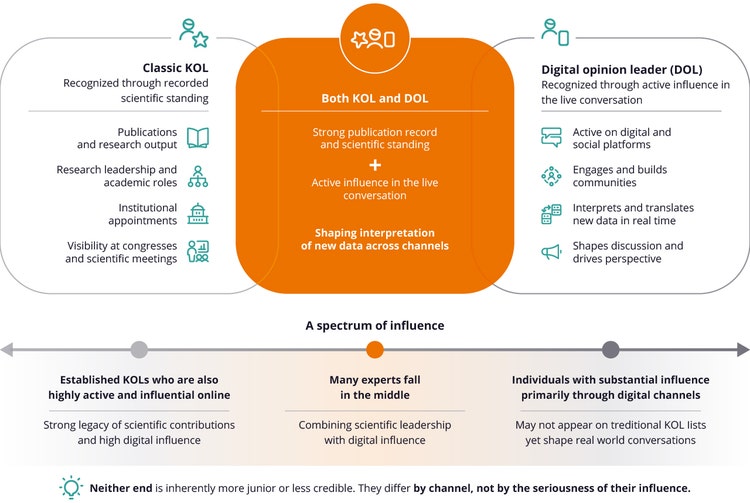
The distinction from a classic KOL is not simply seniority or credentials. It is where influence lives. A classic KOL is often recognized through recorded scientific standing: publications, research leadership, institutional roles and congress visibility. A DOL is recognized through active influence in the live conversation. Many experts are both a KOL and a DOL, having a strong publication record and shaping interpretation of new data through digital channels.
For that reason, influence is better understood as a spectrum than as two separate groups. At one end are established KOLs who are also highly active and influential online. At the other end are individuals who have built substantial influence primarily through digital channels and may not appear on a traditional KOL list. Neither end is inherently more junior or less credible. They differ by channel, not by the seriousness of their influence.
Many experts are both KOLs and DOLs, combining a strong scientific record with active influence in today’s live conversations.
FIGURE 1: The influence spectrum: mapping traditional scientific standing against digital reach
Why DOLs matter now, especially for midsize and emerging pharma
DOLs are especially important for midsize and emerging pharma companies. These teams typically have smaller field medical functions, narrower geographic coverage and fewer established relationships across the scientific ecosystem than large pharma. That limits how much of the scientific conversation they can reach through traditional channels alone, not because the team is any less capable, but because reach through MSL conversations, advisory boards and congresses is bound by headcount and time.
Digital influence changes the math. Because a DOL’s reach can compound across peer networks, engaging the right digitally active voices allows a smaller team to create presence in the scientific conversation that would be difficult to achieve through traditional touch points alone.
Consider what this looks like in practice. A single MSL can hold perhaps a few dozen meaningful scientific conversations a quarter, each valuable but contained to the people in that room. A credible, digitally active expert who shares a considered view on a new data readout can reach several thousand peers in the same period, and those peers carry the perspective into their own networks. For a large pharma with hundreds of field staff, that difference is useful. For a lean team, it is the difference between being part of the conversation and being absent from it. This is closely tied to scientific share of voice: how present and influential a company’s science is in the relevant clinical conversation. For midsize and emerging companies, credible DOL engagement can help earn a disproportionate share of that conversation. When the right evidence reaches practicing HCPs sooner and is reinforced through trusted peer networks, scientific exchange becomes broader, earlier and more connected to the decisions that ultimately affect patient care.
Knowing why DOLs matter is clear. But the real question is how to identify the right ones and engage them well.
How to identify and engage DOLs
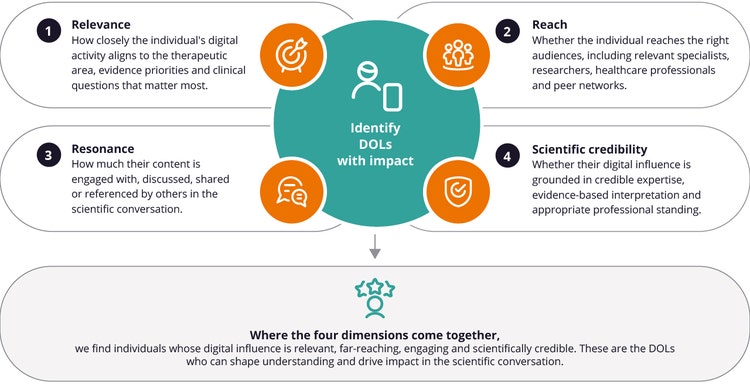
Identifying DOLs should not depend on intuition or follower counts alone. A large audience can signal-reach but reach without therapeutic relevance or scientific credibility does not create the kind of influence medical affairs needs. A repeatable approach requires looking at four dimensions together:
1. Relevance: How closely the individual’s digital activity aligns to the therapeutic area, evidence priorities and clinical questions that matter most.
2. Reach: Whether the individual reaches the right audiences, including relevant specialists, researchers, HCPs and peer networks.
3. Resonance: How much their content is engaged with, discussed, shared or referenced by others in the scientific conversation.
4. Scientific credibility: Whether their digital influence is grounded in credible expertise, evidence-based interpretation and appropriate professional standing.
FIGURE 2: A four-part framework for identifying DOLs is a repeatable approach that looks at four dimensions together
Engaging DOLs also requires a different motion. Medical affairs teams need to lead with value, whether that is meaningful data, genuine scientific exchange or co-created education, rather than promotion, matching the right voice to the right topic and build consistent presence over time rather than relying on one-off contact. It also helps to listen before engaging, using social listening to understand the conversation and where the open scientific questions are before joining it. The goal is to participate in the scientific conversation in a way that respects how digital influence travels: quickly, publicly and through networks of peer validation.
Compliance should be built into the engagement model from the start, with clear roles, approved scientific content, appropriate monitoring and the same standards that already guide medical affairs engagement in other settings. Digital does not lower the bar on regulatory and disclosure standards; if anything, it raises it. It simply requires the organization to account for the channels where scientific exchange now happens.
How ZAIDYN makes DOL engagement practical at scale
The challenge is not understanding that digital influence matters. It is making DOL identification and engagement practical across therapeutic areas, geographies and medical objectives.
ZAIDYN Opinion Leader Intelligencehelps make this more scalable by bringing traditional and digital influence into one view. Built on an HCP knowledge graph that spans scientific, clinical and social signals, it identifies and profiles experts using criteria your team defines for its own strategy, rather than a fixed, one-size-fits-all list. That means a team can see which experts hold established scientific standing, which voices are shaping active digital conversations and how those individuals are connected across the wider influence and referral networks through which scientific knowledge actually travels.
Because the same definition of influence can be applied consistently across brands, therapy areas and regions, the view holds up as a team scales, instead of fragmenting into separate lists maintained by hand. It also surfaces rising and emerging experts on a trajectory basis, so a team can engage tomorrow’s influential voices while they are still accessible, not after they have already shaped the conversation.
That combined view helps leaders prioritize who to engage, what topics to focus on and where engagement can support the greatest scientific impact.
It’s the engine that helps the team see more clearly, decide faster and engage with greater precision—across both traditional and digital conversations.
A broader view of influence for a changing scientific conversation
As scientific influence has expanded into digital channels, traditional methods of measurement no longer show the full picture. But medical affairs doesn’t need to abandon the traditional KOL model to adapt--it needs to expand it to see both.
By including DOLs, they can have a clearer view of where scientific interpretation is moving, who is shaping it and how evidence travels through peer networks. With such better visibility into influence, they can create more intentional engagement and a medical affairs strategy that reflects how the scientific conversation actually works today.
Related resources



See ZAIDYN in action
