Enabling impact visibility in medical affairs with agentic AI
Key takeaways
- Medical affairs impact attribution is the ability to link specific medical activities to measurable changes in clinical decision-making (not just engagement volume such as interactions, reach or frequency).
- A unit of change is a complete, traceable care-pathway sequence (opportunity points, stakeholders, interventions and outcome signals) that connects medical affairs actions to observed practice change.
- The 3A Mindset for medical impact attribution (anchor, associate, amplify) operationalizes attribution by anchoring impact to decision points, associating actions across the care pathway and amplifying the interventions most likely to drive change.
- Agentic AI enables attribution at scale by linking field insights, engagement records and outcome signals, then detecting nonlinear patterns over time to recommend next best medical engagement actions.
Medical affairs has never been closer to patient impact. From creating scientific evidence to driving stakeholder education and improving clinical practice, medical affairs plays an increasingly central role in value delivery. Despite this, one question continues to challenge its strategic role: What changed because of medical affairs?
Most pharma organizations struggle to answer this with confidence—not because the impact does not exist, but because it cannot be clearly attributed. As expectations rise, this gap is becoming more consequential. Leadership is no longer satisfied with the lack of visibility into impact.
The industry has largely treated this as a measurement problem. But at ZS, we think it’s not. The underlying issue is that medical affairs has historically measured units of effort, rather than units of change.Real AI value shows up when it is embedded in the decisions and actions that drive outcomes, not added as another layer on top of existing workflows.
Is it a medical affairs measurement problem or a value definition problem?
Medical affairs has not struggled due to a lack of metrics. In fact, most organizations track engagement in significant detail.
The issue is that these metrics are built around:
- The number of interactions
- The frequency of engagement
- The reach across stakeholders
Even where the impact is clear, it is rarely captured. A study shows nearly 50% of key opinion leaders (KOLs) report changing treatment behavior after medical science liaison (MSL) engagement, yet 92% of organizations still measure MSLs primarily on activity metrics.
The function is an enabler for evidence-based clinical decision-making, but the system used to measure it cannot capture that effect. The underlying assumption has often been that activity aggregates into impact and high-quality engagement, at sufficient scale, will ultimately lead to outcomes.
In reality, patient impact is not a sum of outputs. It is the result of coordinated change within the care pathway.
Why demonstrating medical affairs’ impact remains difficult today
Medical affairs does not struggle to create impact. It struggles to consistently demonstrate it in a way that connects actions to outcomes.
Across organizations, capabilities are evolving at different speeds. Some have strong field medical teams generating rich MSL-level insights. Others have more mature strategic planning and engagement models.
Yet a common challenge persists. Activity is visible. Signals of change exist. But connecting the two remains difficult.
This is largely because key components of medical affairs are not fully connected.
Field insights and strategic insights are often captured separately. Engagement data reflects interactions, but not always their impact. Outcome data shows what is changing in clinical practice but is rarely linked to specific actions.
As a result, organizations can describe what they did and observe what is changing but have no data-backed way to confidently connect the two.
This is where demonstrating impact becomes difficult. Not because medical affairs is not influencing outcomes but because it lacks a connected way to show how that impact takes shape.
Redefining the unit of value in medical affairs impact measurement
If impact is the result of cumulative change, then measuring isolated activities will not provide a reliable view of it. Interactions are counted, reach is assessed and engagement quality is evaluated.
These measures offer visibility into effort, but they do not explain whether that effort led to meaningful change. What is required is a unit of value that connects action to outcome.
This can be understood as a unit of change.
A unit of change represents a complete, traceable sequence within the care pathway. It begins with a defined point where variation or opportunity exists, involves the stakeholders who influence that point, includes the actions taken to shape decision-making and culminates in an observable shift in clinical decision-making or practice. Framing work in this way allows medical affairs to move beyond measuring what was done, toward understanding what changed as a result.
What needs to change to make impact traceable
Addressing this challenge requires more than redefining key performance indicators. It requires a way to make impact traceable within the flow of everyday medical affairs work.
Organizations that are able to demonstrate impact do not start by adding new metrics. They start by identifying high-priority decision points within the care pathway where change matters most and then systematically connecting insights, engagement and outcome signals around those priorities to observe impact.
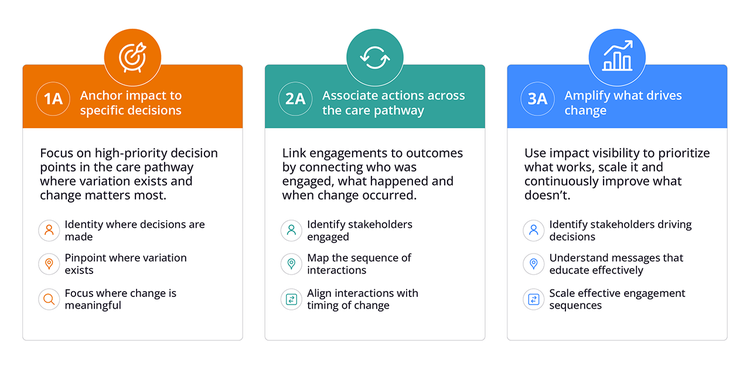
In practice, this comes down to three shifts. Together, they create a more consistent way to connect action to outcome. At ZS, we call them the 3A mindset for medical impact attribution.
- Anchor impact to specific decisions
- Associate actions across the care pathway
- Amplify what drives change
Let’s dive in.
Anchor impact to specific decisions
The first shift is to move from measuring outcomes broadly to anchoring them at the level of specific care gaps.
Most organizations track outcomes at an aggregate level. Market trends, prescribing patterns or patient-level data provide visibility into what is changing commercially but not where that change is occurring in the care pathway—making medical affairs' impact tough to track.
Medical affairs attribution becomes possible only when the impact is localized.
This means identifying:
- Where in the care pathway a decision is being made
- Where variation exists
- And where change would be meaningful
For example, rather than measuring overall treatment adoption, the focus shifts to a specific moment, such as initiation in a defined patient segment or time to treatment after a particular diagnostic step. This creates a clear reference point. Without it, impact remains fragmented and difficult to link to action.
Associate actions across the care pathway
In most pharma organizations, engagements are tracked in detail while outcomes are analyzed separately, but the connection between the two is often assumed rather than demonstrated. Association requires bridging this gap, not through perfect causality but through structured linkage.
This involves connecting:
- Which stakeholders were engaged
- What sequence of interactions occurred
- How those interactions align with the timing of change
When viewed in isolation, none of these elements explain the impact. When connected, they begin to show patterns of practice change. That shift, from activity tracking to outcome attribution, is where real visibility begins.
Amplify what drives change
The final step is to use this visibility to inform action. Once impact can be linked to specific interventions, organizations can identify what is actually working by better understanding:
- Which stakeholders are driving decisions
- Which messages are educating effectively
- Which sequences of engagement are leading to change
This allows medical affairs to move from executing activity to shaping strategy. Resources can be redirected toward interventions that demonstrate practice change. Efforts that do not contribute to change can be reconsidered.
Over time, this creates a feedback system where impact is not only measured but continuously improved.
FIGURE: The 3A Mindset creates a clear path to connect action to outcome and amplify what matters
Agentic AI’s role in enabling attribution at scale
While the approach is conceptually straightforward, executing it at scale is not.
Medical affairs operates across large volumes of interactions, diverse stakeholder groups and multiple disparate data sources. The relationships between these elements are complex and often nonlinear, making manual attribution impractical.
AI enables organizations to address this challenge by connecting fragmented data into a more coherent view. It allows field insights, engagement records and outcome signals to be analyzed together, helping identify patterns that would otherwise remain hidden. AI can also assess sequences of interactions over time, making it possible to understand how combinations of actions influence decisions rather than evaluating them in isolation.
This shifts attribution from a retrospective exercise to an ongoing capability.
The next evolution extends this further. Agentic AI introduces the ability not only to interpret patterns, but also to act on them. These systems continuously monitor signals across stakeholders, engagement and outcomes, identifying where change is emerging and where it is not. Based on these insights, agentic AI systems can surface recommended options, inform engagement strategies and support more adaptive decision-making.
In other words, attribution becomes scalable when the work is designed as a continuous sense-decide-act-learn loop, so insights can reliably trigger governed action and improve over time. This closed loop capability enables medical affairs teams to move beyond analyzing what has happened to actively shaping what happens next.
A more scalable approach to impact attribution
Medical affairs has long delivered impact. What has been more difficult is making that impact consistently visible and attributable. As long as activity remains the primary unit of value, this challenge will persist. Effort will be measured but outcomes will remain difficult to explain.
The shift is to anchor impact where it occurs, attribute how it is influenced and amplify what drives change. With advances in AI and agentic systems, this approach is now scalable and actionable. Organizations can move beyond demonstrating activity to clearly articulating their contribution to clinical outcomes.
To explore how this approach can be applied in practice, you can learn more about ZAIDYN Medical or request a tailored demonstration.
Related resources


See ZAIDYN in action
