5 steps to measuring the impact of a medical affairs list
Key takeaways
- A strong key opinion leader (KOL) list only matters if it advances a clear medical objective.
- Medical affairs should measure KOL impact across the full workflow, from strategy and expert identification to field engagement and insights.
- Look beyond activity counts to track movement in perception, influence, practice and patient outcomes.
After the KOL list is built, the harder work begins
A head of field medical can explain how the organization’s latest KOL strategy has led to a sharper view of influence:
The team used AI to expand beyond the usual names and continues to refresh the list with established experts, digitally active voices and rising leaders who did not appear in last year’s roster. Cross-functional reviewers aligned on the strategy, and medical science liaisons (MSLs) can now use it in the CRM.
But then leadership asks the harder question: What changed because we engaged these people?
Medical affairs showed coverage. It showed tiering. It showed meetings, touch points and regional activity. But it wasn’t able to show whether scientific perception shifted, whether the right voices carried the evidence forward, whether practice patterns moved or whether a care gap began to narrow.
Medical affairs has made significant strides in expert identification. The next opportunity is to demonstrate what that influence actually changes.
Although the industry still calls it a KOL list, today’s list is better understood as a living view of scientific influence—one that evolves with the evidence, expert networks and medical priorities.
And because KOL list-building is rarely owned by one person, measurement can’t stop at the final list. Each part of that system has to be measured, or the team only sees the list, not the work that makes the list matter.
FIGURE: To prove that change, medical affairs needs to measure KOL impact across five connected steps
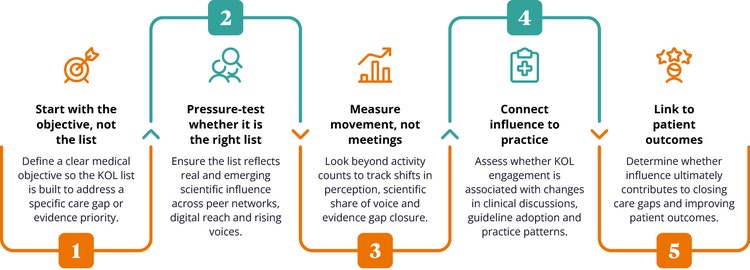
1. Start with the objective, not the list
Before teams can demonstrate impact, the list needs a purpose to anchor it. Too often, medical affairs evaluates a KOL list against itself: how many experts were identified, how complete the profiles are, how much of the list the field reached and whether high-tier experts received enough attention.
Those metrics are useful, but they don’t show whether the list advanced a defined medical objective tied to a care gap, evidence priority, scientific belief or patient outcome. If the goal is to improve understanding of guideline-directed care in a specific condition, the list should be judged by whether it helps move that understanding—not simply whether the team engaged enough prominent experts.
This matters because different teams contribute different forms of value.
Each team has a different role in proving impact. Strategy must define an objective specific enough to guide prioritization. Analytics must build an expert universe that reflects that objective. Field teams must concentrate engagement on the experts most likely to shape the relevant scientific conversation. Insights teams must detect meaningful change over time.
Without that anchor, every downstream metric floats free of what matters.
2. Pressure-test whether it is the right list
A list is only worth measuring if it is the right list. That means asking whether it reflects real influence across peer networks, digital reach, referral relationships and rising voices—or simply the experts the team already knows how to access.
Consider a team preparing for a new evidence communication strategy in a specialty disease area. The legacy list includes the expected academic leaders, publication authors and advisory board participants. But the scientific conversation has shifted. A handful of community-based specialists are translating new evidence into practice. A digitally active clinician is shaping peer discussion after congresses. A rising investigator is becoming central to referral networks in a region the field team had not prioritized.
If those experts are missing, performance metrics can still look good. Coverage can improve. Engagement volume can rise. But the team may be measuring activity against the wrong universe.
Impact measurement should therefore include list quality itself: what percentage of the relevant influence network is represented, how many important voices were newly identified, how quickly emerging leaders are surfaced and whether each expert’s inclusion can be explained by objective-based signals.
3. Measure movement, not meetings
The next shift is from counting interactions to detecting change. Medical affairs has long tracked meetings, frequency, reach and coverage because those numbers are easy to collect and simple to report.
But high activity does not prove that scientific understanding moved.
Medical affairs teams are starting to understand this gap: while 92% of organizations still judge MSL performance mainly on activity counts, 70% believe relationship quality and insight impact are better measures.
Instead, teams should focus on indicators that show whether engagement is creating meaningful change:
Did perception change after engagement? Did the narrative hold across peer conversations? How does our scientific share of voice grow compared to our competitors? Did the team hear fewer recurring misconceptions over time? Did insights from the field show that evidence gaps were being resolved rather than repeated?
Activity metrics are simple, but impact metrics show change:
Actvity metrics
- Meetings held
- Touch points
- Coverage
- Frequency
- Regional activity
Impact metrics
- Perception shift
- Scientific share of voice
- Narrative consistency
- Evidence gap closure
These measurements should show whether the workflow is creating momentum, not just activity. Field medical engagement should reveal whether the right experts are advancing the conversation. Analytics should show whether influence patterns are changing across the network. Insights should indicate whether recurring evidence gaps are being resolved.
Together, those signals help leaders see whether engagement is moving the science, not simply documenting effort.
4. Connect scientific influence to practice and patients
Scientific influence only counts when it reaches care. A KOL may understand the evidence, support the science and share it with peers. But the endpoint is not advocacy on its own. The endpoint is whether the right scientific understanding travels far enough to change practice for patients.
That does not mean every KOL engagement can be tied immediately to a clinical outcome. Guideline incorporation, practice change and care gap closure move on longer timelines. But teams can build a chain of evidence: engagement with objective-relevant experts, movement in perception or insight themes, changes in peer discussion, evolution in treatment approaches and, eventually, narrowing of the care gap the strategy was built to address.
In practical terms, this means measuring both leading and lagging indicators. Early measures may include share of priority experts engaged, percentage of the relevant network reached, insight quality, scientific understanding and evidence message resonance.
Later measures may include changes in scientific adoption, peer influence patterns, treatment behavior or patient outcome indicators in the populations where the care gap exists.
This is the point at which the KOL list becomes part of an evidence trail from medical strategy to measurable impact.
5. Keep the measurement dynamic and defensible
KOL impact measurement cannot be a once-a-year slide. Influence changes. Evidence changes. Digital conversation changes. Referral patterns, guideline discussions and peer networks change.
A list that was right six months ago may no longer reflect the experts shaping the next decision point.
That’s why measurement has to refresh alongside the strategy. The team should be able to see when an expert’s relevance increases, when a new voice emerges, when engagement is shifting perception and when a part of the workflow is no longer producing the intended effect.
The question is not just, “Did the list perform?” It is, “What did we learn, and how should the list change next?”
Defensibility matters just as much. When leadership asks why these experts, why this engagement and why this counts as impact, the team needs a clear signal trail.
That includes the objective each expert maps to, the evidence behind their relevance, the engagement history, the insights captured and the indicators of change. A number without explanation is easy to dismiss. A connected, objective-based view is much harder to set aside.
How ZAIDYN Medical helps prove KOL impact
Many applications help teams build expert lists. The harder work is turning those lists into a living view of influence that connects to engagement planning, insight generation and impact measurement.
ZAIDYN Medical is purpose-built for medical affairs teams that need to identify the experts who matter, understand why they matter and measure whether engagement is advancing the medical objective. It brings scientific, clinical, network, digital and field intelligence signals into one AI-driven view, helping teams replace static lists with dynamic expert intelligence that can be refreshed as the science and conversation move.
That intelligence helps teams build stronger KOL strategies, prioritize the right experts and guide scientific engagement. Connected with broader medical intelligence and impact measurement capabilities, it also provides a foundation for understanding how that engagement contributes to scientific and clinical change.
In a medical affairs environment where leaders are expected to demonstrate measurable impact, the KOL list cannot remain a roster a team maintains. It has to become a system of influence the organization can see, prove and improve.
Related resources



See ZAIDYN in action
