How medical affairs turns scientific intelligence into patient impact
Key takeaways
- The longer the insight waits, the less impact it can have
Medical affairs succeeds when scientific insights become action before the opportunity passes.
- Leading teams work differently
They continuously detect, connect and act on emerging scientific intelligence instead of relying on periodic reporting.
- AI accelerates—not replaces—expertise
Agentic AI reduces manual synthesis so medical affairs teams can focus on scientific judgment.
Scientific intelligence only matters if it reaches the right people in time
Medical affairs teams aren’t short on scientific insights—they’re short on time. Valuable signals emerge every day through medical science liaison (MSL) conversations, congresses, advisory boards and scientific publications. Yet by the time those signals are connected, synthesized and shared, the opportunity to shape decision making may already have passed.
Every delayed insight is a missed opportunity to inform healthcare professionals while questions are still being asked and treatment decisions are still taking shape. For medical affairs, improving that timeline is one of the greatest opportunities to strengthen scientific exchange and improve patient care.
To see how this challenge unfolds and what leading teams are doing differently, let’s explore a hypothetical, real-world scenario.
The medical insight that arrived too late
Imagine an MSL at a major oncology congress hearing the same hesitation from several healthcare professionals. They’re uncertain about a newly discussed safety finding and how it should influence clinical decisions. Individually, each conversation is valuable. Together, they reveal an emerging scientific signal.
The MSL captures the insight correctly and logs it through the organization’s established reporting process. Nothing goes wrong in the field.
The insight then enters the normal reporting cycle. It’s one of thousands of observations waiting to be reviewed, synthesized and turned into a report. Weeks pass before it reaches the people responsible for medical strategy. By then it’s too late, and the opportunity to respond while the discussion was actively shaping clinical understanding has closed.
The insight was good. But the process around it was too slow.
Medical affairs teams generate valuable scientific intelligence every day. Yet when insights surface continuously and are only reviewed and addressed at periodic monthly or biweekly insight forums, organizations struggle to respond while scientific conversations are still unfolding. Opportunities to educate healthcare professionals, inform evidence planning and shape scientific engagement become harder to recover once the moment has passed.
That’s the challenge facing medical affairs today. The goal isn’t to collect more scientific intelligence. It’s to ensure the right insights reach the right people while they can still shape the medical strategy and patient care. In the end, this is less a reporting challenge than a decision one.
The medical insights are everywhere. The unified picture rarely is.
Every day, valuable signals emerge across the organization—from MSL conversations, advisory boards, congresses, medical information inquiries and digital channels. Each interaction offers another piece of the scientific landscape, helping medical affairs teams understand emerging questions, shifts in clinical sentiment and unmet educational needs.
Yet these sources often live in separate systems, follow a different process or serve a different purpose. MSL notes may sit in one platform, medical information requests in another and congress observations in a third. Valuable insights exist across all of them, but they’re rarely connected in a way that reveals the bigger picture.
Many organizations are still working to solve this problem. In ZS’s 2026 Medical Affairs Outlook Report, which surveyed medical affairs leaders across the life sciences industry, only about 15% said their insights were well connected to evidence generation planning. Most saw room for improvement, and just 5% described their insights-to-action process as fully mature.
As a result, medical affairs teams spend significant time manually gathering, reviewing and synthesizing information from multiple sources before they can identify meaningful trends. By the time a unified view emerges, it’s already a snapshot of where scientific conversations were—not where they’re heading.
That lag matters because scientific conversations don’t pause while organizations assemble reports. New data are presented at congresses. Healthcare professionals ask new questions. Clinical sentiment evolves. Emerging themes continue to develop, even as teams work to understand the last reporting cycle.
Without a continuously connected view of scientific intelligence, organizations risk responding to yesterday’s priorities instead of today’s emerging needs. The result isn’t a lack of insight—it’s a delay in recognizing which insights require action now.
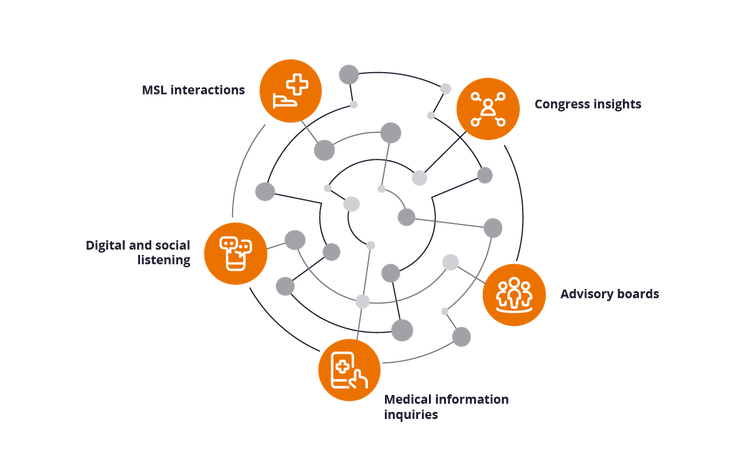
FIGURE: Scientific intelligence emerges across many sources
Medical affairs teams gather scientific intelligence from MSL interactions, congresses, advisory boards, medical information inquiries and digital channels. Each source offers valuable signals, but without a connected view, emerging themes can remain difficult to recognize and act on in time.
What the lag costs medical affairs
Missed moments for HCP education
Healthcare professionals often seek answers soon after a congress presentation, new data release or evolving safety discussion. Those moments create a limited window to clarify emerging questions and provide balanced scientific education.
When scientific insights surface too late, that window may already have closed. Healthcare professionals continue making decisions based on the best information available to them at the time, even as new scientific understanding is still making its way through the organization.
The consequence is bigger than a missed interaction. It’s a missed opportunity to support clinical decision-making when it matters most.
Reactive evidence planning
Scientific intelligence also shapes decisions about evidence generation, publications and future research priorities.
When organizations rely on historical reporting cycles, those priorities are often informed by yesterday’s scientific landscape instead of today’s emerging questions. Teams respond to evidence gaps after they’ve become apparent rather than anticipating where new data will be needed next.
For patients, that delay can have lasting consequences. In ZS’s 2026 Medical Affairs Outlook Report, 59% of KOLs said they changed how they treat patients after engaging with MSLs and 55% switched a treatment or line of therapy. When scientific intelligence reaches clinicians in time, it changes care.
Lost scientific leadership
Scientific dialogue continues whether an organization participates or not.
While valuable insights remain fragmented across reporting processes, healthcare professionals continue asking questions, new data continue to emerge and competing scientific narratives continue to influence understanding.
Medical affairs is uniquely positioned to contribute objective, evidence-based scientific engagement during these moments. Delays make that role more difficult to fulfill, allowing others to shape the conversation first.
By the time a report confirms what the field has already experienced, the conversation has often moved on.
The cumulative impact of these delays isn’t measured only in operational efficiency. It’s measured in missed opportunities to educate healthcare professionals, inform evidence priorities and contribute to scientific conversations while they are still evolving. As the pace of scientific change continues to accelerate, shortening the time between insight and action becomes increasingly important for organizations committed to improving patient care.
How leading medical affairs teams close the gap
Leading pharma organizations aren’t responding to faster scientific change by adding more reporting, more meetings or more people. They’re changing how scientific intelligence flows through the organization.
Rather than treating scientific intelligence as a series of disconnected activities, they treat it as a continuous capability—one that helps teams recognize emerging signals, understand what they mean and respond while opportunities to influence scientific dialogue are still open.
That shift can be understood through three connected actions.
See it early.
Scientific shifts don’t begin in a quarterly report. They begin in conversations—with healthcare professionals at congresses, through MSL interactions, advisory boards and medical information requests.
Leading organizations continuously monitor these signals as they emerge instead of waiting for a reporting cycle to reveal a trend weeks later.
The advantage isn’t simply seeing more information. It’s recognizing meaningful changes while there is still time to respond.
See it whole.
Individual observations rarely tell the full story.
Leading organizations connect scientific signals across sources to create a unified view of emerging themes. Rather than reviewing MSL notes, congress insights and medical information requests independently, they understand how those signals reinforce one another, which healthcare professionals are affected and where scientific understanding is beginning to shift.
That context allows medical affairs teams to move beyond isolated observations and make decisions based on a more complete picture.
See it through.
Insight only creates value when it leads to action.
Organizations closing the gap translate scientific intelligence into timely HCP education, evidence planning and scientific engagement before opportunities are lost. Instead of reacting after a trend has already taken hold, they respond while scientific conversations are still evolving.
That ability to move from insight to action helps medical affairs teams contribute at the moments when they can have the greatest influence.


What agentic AI makes possible for medical affairs
Agentic AI doesn’t replace scientific judgment. It helps medical affairs teams continuously detect, connect and prioritize emerging scientific signals across the organization. Rather than waiting for teams to manually gather and synthesize information, agentic AI surfaces meaningful patterns as they emerge, giving experts a continuously updated view of the scientific landscape.
The result is a fundamentally different approach to scientific intelligence—one that enables organizations to recognize emerging shifts while they can still influence scientific dialogue.
Consider the MSL at the oncology congress. In a traditional reporting process, the emerging concern about a therapy’s safety finding would enter a queue of thousands of observations, reaching medical strategy only after the congress had ended and the opportunity to respond had passed.
Organizations taking a continuous approach to scientific intelligence experience that moment differently. Their teams:
- See it early. Similar observations begin surfacing across MSL conversations and congress interactions in near real time.
- See it whole. Signals are connected with related scientific discussions, medical information requests and the healthcare professionals most affected by the emerging question.
- See it through. Medical affairs teams can prioritize education, refine evidence plans and engage healthcare professionals while the discussion is still unfolding—not weeks after it has moved on.
For these organizations, the scientific insight remains the same. What changes is their ability to recognize important signals and respond while opportunities to influence scientific dialogue are still open.
By shortening the time between insight and action, medical affairs teams can help ensure emerging scientific understanding reaches healthcare professionals when it can still inform decisions, evidence generation and patient care. And patients spend less time waiting for scientific knowledge the organization already possesses.
Related resources


See ZAIDYN in action
