Measure what matters: How agentic AI is changing the way medical affairs measures impact
Key takeaways
- Measure movement, not volume. Medical affairs impact is the change from scientific understanding to clinical behavior and, ultimately, patient outcomes—not the number of activities completed.
- Measure less and focus on what drives the decision. Choose one north-star behavior change, pair it with the shift in understanding that explains it and anchor both to a patient outcome, using activity measures only as tie-breakers.
- Let AI assemble the evidence, not make the judgment. Agentic AI can connect fragmented data and continuously surface patterns, while medical teams retain ownership of scientific intent, interpretation and action.
Why medical affairs needs a clearer line of sight to patient impact
Medical affairs contributes more to patient care than ever—shaping evidence strategies, guiding treatment decisions and helping move clinical practice toward better outcomes. As the function has become a strategic pillar alongside R&D and commercial, expectations have risen with it.
Leaders have now committed to making the value of medical affairs clear inside the organization, where priorities and budgets are set, and outside it, where the scientific narrative takes shape.
But while most organizations recognize that activity counts no longer reflect the true value medical affairs delivers, few have successfully shifted to measuring impact.
How scientific exchange drives changes in clinical practice
The evidence that medical affairs changes practice is increasingly clear.
According to the ZS Medical Affairs Outlook Report 2026, more than half of key opinion leaders (KOLs) changed treatment approaches, switched therapies or shared information with peers after interactions with medical science liaisons (MSLs). KOLs who found MSL information highly relevant were far more likely to recommend those MSLs to colleagues as a trusted source of information.
This research shows that scientific exchange can influence what trusted experts understand, discuss and do.
Yet the same report points to a harder problem: Teams still struggle to express that influence at the patient level and connect scientific exchange to changes in real-world practice.
A strong interaction may shape an HCP’s interpretation of evidence, close a knowledge gap or alter a treatment decision, but those effects often sit across different data sources and time horizons.
By the time results reach a dashboard, the thread connecting scientific exchange to changes in understanding, behavior and care has been reduced to an activity count—and the outcome itself is no longer visible.
Why activity metrics fail to demonstrate medical affairs value
Most medical impact dashboards still lead with what’s easiest to count: HCP interactions, KOL meetings, publications, insights captured, congress attendance, emails sent and response times. These measures track execution, but they don’t reveal whether scientific understanding changed or whether that change influenced care.
As a result, a field-shaping scientific exchange can look identical to a routine touch point. A genuine breakthrough can read like one more logged interaction, causing high-impact work to be undervalued when investment decisions are made and leaving the story of what medical affairs drove to be told by others—or not at all.
Without a clear distinction between activity and impact, high-value scientific work can look like business as usual—weakening the case for continued investment and obscuring what changed because medical affairs acted.
This raises the real question: If activity isn’t the measure, what is?
How to measure medical affairs impact from objective to patient outcome
Around 90% of organizations already track activity. Adding more dashboards and readouts to that creates noise rather than clarity because, when everything is a metric, nothing is the metric.
Instead, teams have started moving to measuring the impact these activities as a whole have had on patient outcomes. Impact is the measured change in what HCPs understand, do and ultimately deliver for patients. To trace that change back to a defined medical objective, teams can frame impact as a chain of horizons: medical objective, activity, changes in knowledge and belief, changes in clinical behavior and patient outcomes.
Impact is then measured as the movement along that chain, not the count of activities across it.
FIGURE: What is impact for medical affairs?
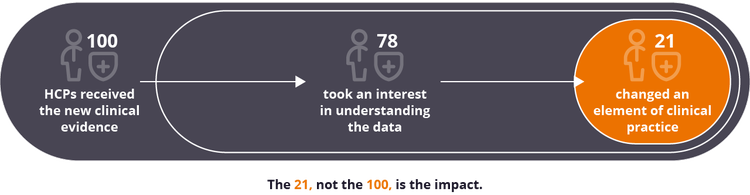
This approach changes the measurement question from “What can we count?” to “What evidence helped us decide?” For each medical objective, teams identify a north-star behavior change and pair it with the knowledge or belief shift that explains why the behavior is moving.
Both remain anchored to a patient outcome. Activity counts still have a role, but as context or tie-breakers rather than the headline.
A simple everyday example can help illustrate this principle. When choosing a phone, we consider several features, but a few key priorities ultimately guide our decision:
- North star: Camera and battery performance
- Explained by: The features that make the phone fit the buyer’s priorities
- Tie-breakers: Screen, weight and price
- Decision: Select the phone that best meets the priorities that matter most
Defining this hierarchy for medical impact is only the first step. To use it consistently, teams must connect evidence across objectives, interactions, understanding, behavior and patient outcomes—a task that has historically been difficult to sustain at scale.
How agentic AI connects medical affairs activity to patient impact
This level of clarity was always the goal. What held it back was the effort required to assemble the chain manually across therapy areas, channels and datasets.
Medical objectives might live in strategy documents; interaction data in CRM systems; insights in unstructured notes; and evidence of behavior or patient outcomes somewhere else. Connecting those signals repeatedly was too slow and resource-intensive to sustain.
Agentic AI changes the equation. Purpose-built agents can connect the data teams already have, organize it against the impact horizons and continuously surface where movement is—or is not—occurring.
Instead of a static retrospective readout, teams gain a decision-ready view of the chain from activity through patient outcomes, including where a knowledge gap persists or a behavior change has stalled.
Built specifically for medical affairs, ZAIDYN Medical Patient Outcomes Impact uses agentic AI to connect existing data across the impact chain and create a clear, decision-ready view of how scientific engagement is changing understanding, influencing care and advancing patient outcomes.
Medical teams set the scientific intent and interpret what the evidence means; ZAIDYN does the heavy lifting of assembling the signals so leaders can see their impact, prove it and build on it.
The result is more than a better dashboard. It’s a practical feedback loop. Teams can see what’s working, understand why, redirect effort when needed and build on demonstrated impact.
Ultimately, this gives leaders a clearer basis for investment decisions—and gives medical affairs a credible way to demonstrate how its work changes understanding, improves care and advances outcomes for patients.
Related resources



See ZAIDYN in action
