Why AI-driven KOL engagement is the next frontier for medical affairs impact
Key takeaways
- Medical affairs teams have improved key opinion leader (KOL) engagement, but there is room to do more.
- AI can help teams move beyond static expert lists by continuously identifying which experts are most relevant to a specific care gap, strategy or scientific objective.
- The greatest value comes when teams connect clinical objective setting, expert identification and personalized medical science liaison (MSL) engagement into one adaptive loop.
Medical affairs needs a more precise way to turn KOL engagement into meaningful scientific progress
A head of field medical is asked in a governance review to explain why the team is prioritizing certain experts and not others. The answer should be clear, strategic and defensible. Instead, it rests on a familiar mix of shared vendor lists, manual spreadsheets, legacy relationships and periodic internal review.
According to the ZS Medical Affairs Outlook Report 2026, nearly 60% of medical affairs professionals said their organizations had adopted centralized approaches for tracking launch performance and impact. When measurement gets this specific, the expectation to justify who the team engages, and why, gets specific too.
While medical affairs has improved KOL engagement through more interactions, larger databases, better CRM systems and stronger reporting, the infrastructure behind this strategy is still limited. Most medical affairs teams still build KOL strategies from familiar signals: publications, congress activity, trial leadership, advisory roles, referrals and internal relationship history. These inputs are useful, but they can overemphasize prominence when the strategy requires relevance.
Influence should be defined by the objective. Depending on the care gap, the people who matter most may be well-known academic leaders, or they may be public health voices, guideline authors, policymakers, patient advocacy leaders or digital opinion leaders who often don’t surface in standard lists.
How AI helps medical affairs identify the right KOLs for each care gap
The advent of AI has been a game changer for KOL identification. It enables teams to define influence around the strategy or a care gap or an outcome medical affairs is trying to drive.
Instead of treating influence as a fixed attribute, AI continuously evaluates the signals that make someone relevant to a specific objective: what they publish, where they speak, who they connect with, which communities they influence, how their priorities are changing and how their activity aligns to a care gap.
It then makes its own reasoning visible, showing why an expert is relevant, which signals support that conclusion and how influence flows through the network. This explainability is what makes AI-enabled expert mapping defensible in governance discussions and useful for field teams preparing for engagement.
FIGURE: From static KOL lists to contextual AI-driven engagement
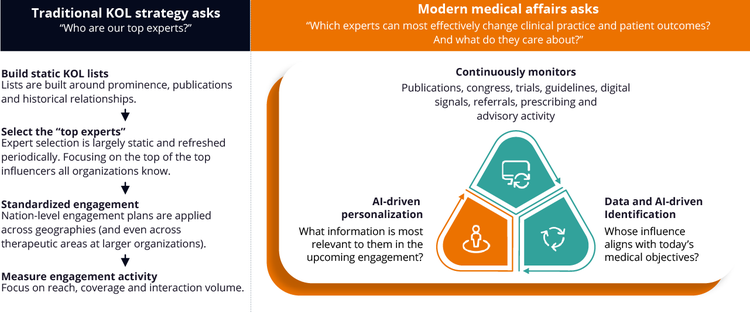
Just as important, AI keeps the view current. Scientific priorities, expert interests and clinical conversations change constantly. If the system can’t refresh as the science moves, it’s not solving the core problem. It’s only digitizing the old one.
How medical affairs leaders should evaluate AI for KOL strategy
AI-enabled KOL strategy should be treated as a capability, not just a tool. The reason for investing is that AI removes a tradeoff manual methods have never solved: keeping a view of influence comprehensive, current and specific to your objective all at once. Before investing, medical affairs leaders should pressure-test for the capabilities manual curation cannot deliver:
- Can it rederive relevance when the objective changes? A static list can be tailored once. The test is whether the view can be recut for a new care gap, therapy or strategy on demand, from the same signal base, without starting over.
- Can it surface influence you would not have found on your own? Not whether it confirms the names you already know, but whether it reveals emerging leaders, network connectors and digital voices that never show up in standard lists, before they become obvious to competitors.
- Does it stay current on its own? This is the hardest thing to do by hand. A list is a snapshot that decays. The test is whether the view refreshes as the science and the conversation move, rather than waiting for the next manual rebuild.
- Is the reasoning defensible at scale? Any tool can show a rationale for a handful of names. The test is whether it can show the signal trail behind every recommendation across the full expert universe, so the answer holds up in a governance review.
Early evidence suggests the impact is real: the ZS Medical Affairs Outlook Report notes that some organizations anticipate an increase in planned engagement capacity of approximately 22% from AI-enabled workflows.
What to expect after the first 90 days
The first 90 days are not about scale, and they are not yet about downstream clinical outcomes. Guideline adoption, practice change and closed care gaps move on clinical timescales, and any tool that claims them in a quarter is overreaching. A leader judging early progress should insist on seeing:
- A validated expert universe for at least one priority therapy area, built around a specific medical objective rather than general prominence. Proving it once on a real strategy is the point, not covering every area at once.
- Influence the team would have missed. Not a reordering of known names, but emerging leaders, network connectors and digital voices that standard lists leave out.
- A mapped network, not a ranked list, so the team can see how influence connects and flows, including referral and peer relationships.
- Sharper MSL planning. Field time should be repointed toward the experts who matter for the objective, with last-mile context, such as referral patterns and channel preference, so outreach is more targeted and less spent validating a stale roster.
- A measurement baseline you could not set before. Share of priority experts actively engaged, coverage of the relevant network, and engagement concentrated on objective-relevant experts rather than raw interaction volume. This is what lets you show progress later.
- A defensible rationale for every name, traceable to the signals behind it, so the answer holds up in a governance or compliance review.
These are leading indicators, not the outcome itself. But they are what the outcome is built on.
How ZAIDYN® supports AI-driven KOL strategy
Many tools and vendors promise the most relevant experts but hand every team they work with a version of the same list. Built once and rarely refreshed, that list is not tied to any one team's objective, so it surfaces the familiar names rather than the right ones. The result is weak engagement planning and inefficient MSL outreach.
The question worth asking is not who holds the largest database of experts. Most vendors can find names quickly. It is whose view is built around your objective and connected to the field workflows and engagement intelligence that follow.
ZAIDYN Medical Opinion Leader Intelligence is purpose built for medical affairs. It supports AI-driven profiling aligned to therapeutic strategy, care gaps and engagement objectives, bringing scientific, clinical, network and digital signals into one view. Because it is configured to a team's own business rules and priorities, the view is specific to the strategy at hand rather than a shared default, and it stays current as the science and the conversation move.
That connected view helps teams identify relevant experts and equip MSLs with timely context for more focused scientific engagement. The result is KOL lists that are current, defensible and aligned to your objectives. It also connects to what comes next, from care gap identification through to scientific intelligence and impact measurement, so the expert view is not a standalone list but part of how the science reaches practice.
Related resources



See ZAIDYN in action
