MSLs in the age of AI: How to earn HCPs’ trust and time
Key takeaways
- As AI makes scientific information easier to access, medical science liaisons (MSLs) can bring greater value by addressing healthcare professional (HCP) questions about interpreting and applying evidence.
- Earning HCP trust now requires more than delivering information: MSLs need to discuss what the evidence supports, acknowledge its limitations and recognize where scientific questions remain unanswered.
- Connecting these insights across the organization can help medical affairs identify recurring scientific uncertainty and inform research, education and future engagement.
An MSL walks into a meeting with an oncologist prepared to discuss a recent clinical trial. The oncologist has already used an AI-powered tool to review the data and understands the headline results.
Now, they want to dive in further about how relevant the evidence is to patients with different clinical characteristics, treatment histories or comorbidities from those represented in the trial.
The MSL can help examine how the evidence relates to the physician’s question, distinguish supported conclusions from uncertainty and identify where further investigation is needed. The conversation becomes worth the physician’s time because it addresses what a summary alone has not resolved.
For medical affairs leaders, this changes the question behind field medical strategy. It’s no longer enough to ask whether MSLs have the latest information. The more useful question is whether they have the context to make that information relevant—and whether what they learn in the discussion can inform their organization’s next steps.
How AI is changing HCP expectations for scientific exchange
The ZS Medical Affairs Outlook Report 2026 found that key opinion leaders (KOLs) believe AI could potentially supplement close to 40% of the scientific information traditionally provided by MSLs, particularly literature summaries, trial overviews and guideline updates.
Yet KOLs value scientific discussions that challenge their thinking. The same report found that KOLs who rated MSLs highly on this ability engaged with them more frequently and were more likely to anticipate increased access to MSLs in the future.
This indicates that MSLs are still valued, but they will need a deeper understanding of each HCP’s scientific questions, evidence needs and clinical environment to make every interaction meaningful.
Trust is then earned by a discussion that is relevant and balanced, including a clear account of uncertainty—not by an assumption that every question has an answer.
How MSLs can identify unresolved HCP questions about clinical evidence
While many HCPs understand published evidence, they still face uncertainty about its applications in practice. They may have questions about patient subgroups, diagnostic approaches, treatment sequencing, long-term safety or differences between guidelines and local care.
Each points to a different scientific need. Treating them all as requests for more information misses the distinction.
Consider several oncologists who understand the reported benefits of a biomarker-guided treatment but question how well the evidence represents a patient subgroup underrepresented in the trials. A useful MSL exchange would examine the available subgroup evidence, distinguish supported conclusions from remaining uncertainty and capture the unanswered question for medical review.
These discussions represent valuable intelligence. They also can help medical affairs teams identify priorities for future research and education.
How medical customer engagement brings scientific context into MSL workflows
Recognizing an unresolved scientific question is only part of the task. Earning the physician’s time means using that understanding to make the next conversation more relevant. When questions remain buried in CRM notes or are reviewed long after engagement, MSLs may miss the opportunity to return with evidence or follow-up that addresses the physician’s earlier concern.
Bringing care-gap signals, stakeholder context and relevant evidence into MSL preparation creates a consistent foundation for scientific exchange tailored to each HCP’s needs.
FIGURE: How AI-driven customer engagement supports more relevant MSL interactions
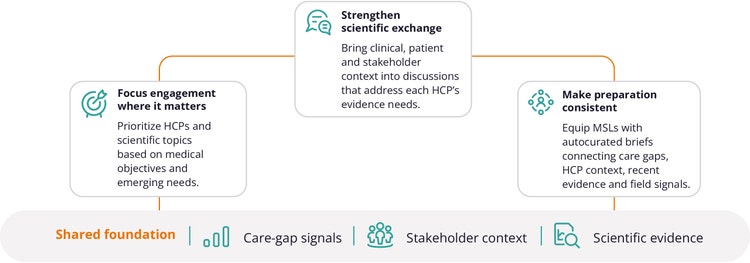
In the biomarker example, this preparation would help the MSL return to the physician’s subgroup question with relevant evidence and context from prior interactions.
AI can also help medical teams identify similar questions across field notes, advisory boards and congress interactions. Medical leaders can assess whether the pattern warrants additional evidence generation, education or updated resources. Bringing that learning back into subsequent conversations helps MSLs demonstrate that the physician’s questions have informed meaningful follow-up—not simply another recorded interaction.
How AI can help scale MSL impact
Scaling this level of scientific relevance requires connected intelligence about the HCP, the evidence and the broader patient-care context. AI can help MSLs understand stakeholder interests, identify relevant scientific developments and prepare for unresolved questions before an interaction. Afterward, it can structure and connect field insights so medical teams can recognize emerging needs sooner and use that learning to guide future conversations.
ZAIDYN Medical brings together that required connected intelligence through its Opinion Leader Intelligence, Scientific Medical Intelligence and context-aware Medical Customer Engagement capabilities. Together, these products help teams understand stakeholder interests, prepare with relevant scientific context and content and connect insights from engagement to future conversations—all while keeping MSLs in the loop for review and governance.
Connected intelligence can help MSLs earn physicians’ time by focusing conversations on unresolved scientific questions rather than familiar information. It can support trust by helping MSLs discuss relevant evidence, acknowledge its limitations and follow up on outstanding questions.
Earn HCP trust by making scientific conversations more valuable
As AI changes how HCPs access scientific information, the opportunity for MSLs now is to bring the scientific expertise and contextual understanding that make a discussion worth having.
For medical affairs leaders that means equipping the field to understand the question behind the request, prepare with relevant evidence and connect what is learned to the wider organization.
A connected intelligence approach can help that knowledge travel beyond individual interactions, informing medical strategy, evidence generation and scientific education.
The MSL who earns an HCP’s time will not necessarily be the one who brings more information. It will be the one who helps create a clearer understanding of what the evidence means—and where the questions remain.
Related resources



See ZAIDYN in action
