6 principles that separate first-launch leaders from the rest
Key takeaways:
- Launch advantage starts before approval. Successful biotech teams use the prelaunch window to put data, workflows and AI foundations in place early.
- AI scales when trust comes first. In a first-launch environment, agentic AI creates value when governance, explainability and clear human accountability are designed in from the start.
- The right roadmap supports launch and compounds value. Modular, connected systems help emerging biotechs execute today while creating a scalable foundation for future products and growth.
For emerging biotech companies, early decisions are especially powerful.
The choices they make at the outset can unlock stronger launches, smarter growth and future scalability.
Unlike large pharma, which can absorb a replatforming midcycle, first-launch companies have one shot at launch excellence. An analysis from ZS shows only about 60% of recent launches met or beat initial peak revenue expectations, and the revenue lost in the first 12-24 months is almost never fully recovered over the product life cycle.
This makes a biotech’s early technology decisions disproportionately consequential. Choices a precommercial team makes about data architecture, AI governance and workflow design in the 18 months before approval will either compound into portfolio value or quietly accumulate into technical debt the next funding round must pay off.
Drawing on our experience with first-launch and growth-stage biotech clients, we’ve distilled six principles that consistently separate launches that compound into a portfolio intelligence engine from those that stall at a single product.
Principle 1: The drug launch readiness clock starts earlier than you think
The highest-performing first-launchers we work with share one defining characteristic: By the time approval lands, they are executing—not building. They use the phase 3 window to establish a full commercial infrastructure stack including:
- A governed data foundation that encompasses the entire customer universe—healthcare providers (HCPs), accounts, hospitals, payers and patient support pathways—not just one channel
- A master data platform with clean identity resolution across every customer archetype the therapy requires
- A CRM architecture wired for field, medical and market access teams simultaneously
- An agentic workflow blueprint that defines, before go-live, which decisions will run autonomously and which require human judgment
The period from the start of phase 3 to a standard Prescription Drug User Fee Act target action date typically lasts 24-36 months. That includes roughly 12-18 months of phase 3 trials, followed by a 10-12-month standard new drug application or biologics license application review cycle. This window is a strategic asset.
For a company with one product and one shot at peak revenue, a 6-12 month head start is the difference between a strong launch trajectory and a permanently compressed one.
The teams that use the prelaunch window intentionally—building infrastructure, wiring data foundations and designing agentic workflows—arrive at approval ready to execute. That head start is a structural advantage that compounds forward.
Principle 2: Design the launch readiness roadmap in 3 horizons
A useful framing for first-launch platform decisions is a three-horizon agentic maturity model:
FIGURE 1: The 3-horizon agentic roadmap is designed forward in time, planned in reverse
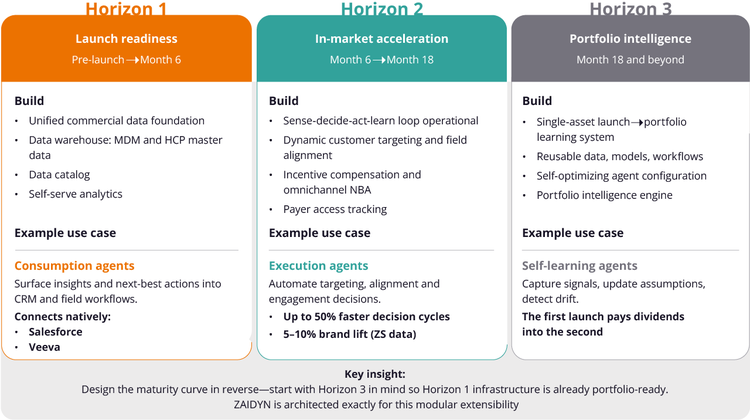
Launch leaders design these horizons in reverse. They start with horizon 3 in mind so the horizon 1 infrastructure is already portfolio-ready. The platforms that hold up across all three horizons have modular, extensible architecture, which is exactly what ZAIDYN® is built around.
Decisions made in horizon 1—which data products to build, which master data management architecture to adopt, which workflow taxonomy to apply—either compound into portfolio value across horizons 2 and 3, or create rework costs that delay the second product. Every first-launch commercial infrastructure decision is also a portfolio decision.
Principle 3: Earn trust with agentic AI before scaling automation
In regulated environments, agentic AI must provide reliable decision-to-execution with full traceability and explicit human accountability. For first-launchers, responsible AI is not just a compliance checkbox, but a trust-building strategy with regulators, payers, HCPs, patient advocacy organizations and the internal commercial teams whose trust in agentic recommendations determines whether the system gets used at scale.
FIGURE 2: 5 agentic AI design commitments that successful launchers consistently use
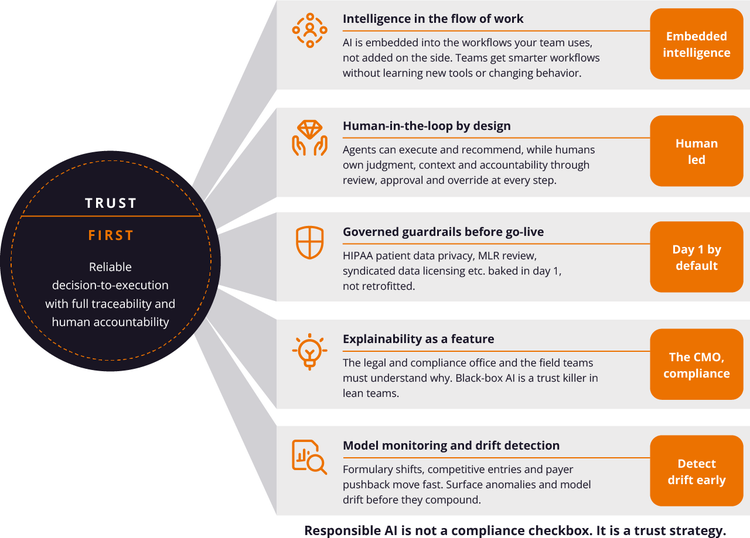
- Intelligence in the flow of work. The most effective agentic AI doesn't ask teams to change how they work. It embeds into the applications and workflows already in use, surfacing insights at the moment of decision, inside the systems where work actually happens. There are no new tools to learn, no parallel dashboards to check and no behavior changes required because the workflow stays the same. The intelligence improves it.
- Human-in-the-loop by design. Agents handle execution-heavy work (data ingestion, KPI generation, scenario exploration and targeting), while humans own judgment and key decisions. Codify explicitly what the agent executes autonomously, what requires review and when the system must escalate.
- Governed guardrails before go-live. Compliance, auditability and traceability are baked in from day 1, not retrofitted. For growth-stage pharma, that means patient data privacy, HIPAA alignment, promotional content review, syndicated data licensing and FDA promotional standards.
- Explainability as a feature. A team lead must be able to explain to the C-suite, compliance team and field rep why the agent made the recommendation it did. Black-box AI kills the trust in lean team environments.
- Model monitoring and drift detection. First-launch markets shift fast: formulary changes, competitive entries, payer pushback. Monitoring agents that surface anomalies and detect drift allow you to catch issues before they compound.
The sequencing matters as much as the principles. Start with narrow, high-confidence use cases and let the team build confidence through observable wins before automating mission-critical workflows. HCP targeting is a reliable first move; account-level intelligence or rare disease patient identification is a strong second, depending on the therapy archetype.
Principle 4: The first 60-90 days decide everything for agentic AI
For first-launchers, onboarding is the moment the organization decides whether AI becomes a trusted partner or an expensive shelfware subscription.
FIGURE 3: 3 phases consistently separate the two outcomes
The instinct to turn on every capability is the most common day 1-30 mistake. In a lean-team environment, cognitive overload kills AI adoption faster than any technical issue. HCP targeting and precall planning are the most reliable starting points because they show up in the field’s daily routine, which means trust is built (or lost) quickly.
The day 30-60 trust moment matters because it reveals whether the data foundation is real or theatrical. If a targeting recommendation doesn’t match what the field already knows, the problem is almost never the model. Master data management (MDM) still has duplicate HCP records, feeds haven’t been wired in or the territory hierarchy is stale. AI cannot rescue a half-built foundation.
By day 90, the diagnostic question shifts from whether the system is working to which AI workflows the team is using without being told to. The ones not being used are not a failure. They’re telling you exactly where trust hasn't been earned yet, almost always because the recommendation can't be explained. Scale what's used. Fix the explainability gap on the rest before scaling further.
The metric worth tracking at day 90 is not login rates or dashboard views, it is whether insights from the platform are appearing in leadership meetings without being prompted. If AI-generated insights are changing decisions, the roadmap is working.
Principle 5: Build a connected system with agentic AI, not a collection of tools
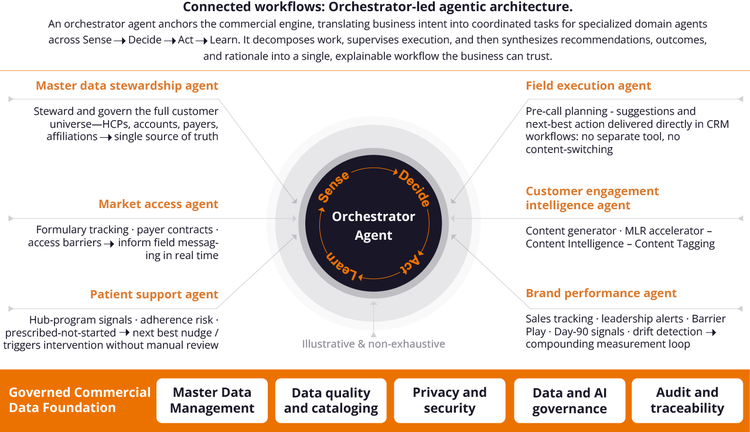
Value compounds when workflows are wired together, not when individual agents are smart in isolation. A fully connected agentic stack for a first-launch pharma company is a connected system of recurring decisions—and the difference between the two is a central orchestrator agent that coordinates domain specialists in unison.
Each workflow is individually valuable. Wired together on a single governed data foundation, sharing context and updating in near-real time, they become an agentic flywheel: an orchestrated commercial intelligence system rather than a set of smart tools sitting next to each other. And because every domain agent is wired to the same governed data foundation, the learning from launch one becomes the infrastructure advantage for launch two—converting the first product into a portfolio intelligence engine.
If the field team is exporting AI recommendations back to Excel to do their own analysis, it’s a diagnostic signal that the system is not yet connected. When that happens, the breakdown is at the adoption layer, not the technology layer, and it has to be addressed before scaling.
Principle 6: Measure launch readiness success across three dimensions, simultaneously
A future-ready agentic roadmap succeeds on three dimensions, and all three need to be tracked at once.
Speed to insight-driven decisions. Are commercial, medical and field teams making decisions in hours or days, not weeks? In enterprise pharma engagements, ZS has seen agentic decision systems deliver 40%-45% savings in analytics execution within nine to 12 monthsand double the speed to insight—the same discipline that, applied at first-launch scale, shows up as early HCP adoption signals and formulary wins in months one through six that echo across the entire life cycle.
The flywheel is turning. Signals flow from the field, models update, targeting refreshes and outcomes feed back in. If the system is producing the same recommendation it was 90 days ago despite new market signals, the loop has stalled—which is the signal to diagnose and re-engage the loop before the next market cycle.
Connected workflows across commercial, medical and patient services. Data is not just clean. It’s connected. HCP engagement signals inform patient support program design. Formulary wins feed field targeting. Medical affairs insights flow into promotional content strategy.
Tracked together, these three dimensions describe a system that is not just deployed but changing how decisions are made. Tracked individually, they describe a dashboard.
The agentic AI roadmap is the asset
For emerging biotech, the AI roadmap is the most important strategic asset before the second product. Every decision about data architecture, workflow connectivity and AI governance in the first launch either compounds into portfolio value or creates technical debt the next funding round will spend itself paying off.
The companies that will lead the next decade of biopharma commercialization are the ones building agentic intelligence systems today: not because the technology is impressive, but because it converts launch learning into a compounding competitive moat—one built not on a single product decision, but on a system that learns, adapts and scales with every launch cycle.
Build it right, build it modular, build it governed and let the flywheel do the work.
ZAIDYN is built for exactly this lean-team, first-launch reality: a modular, AI-ready architecture that lets growth-stage biotech companies start with core prelaunch capabilities and expand seamlessly into postlaunch functions, all on a single governed commercial data foundation.
Related resources



See ZAIDYN in action
