The iceberg beneath pharma AI agents: Cost, governance and the limits of horizontal platforms
Key takeaways
- Agentic AI shifts the pharma build-versus-buy question from software to ownership. Who governs, monitors and improves the agent after it goes live?
- The real cost is the operating layer. Domain logic, governed data, compliance controls, auditability and support determine whether agents can work safely at scale.
- Agentic risk is operational risk. When pharma AI agents act inside commercial workflows, flawed outputs can trigger downstream consequences before teams have time to catch or correct them.
- Purpose-built pharma AI operating layers make agents safe, explainable and accountable in regulated workflows.
A midsize pharmaceutical company had already done the hard part—or so it seemed. Its commercial data lived in a governed cloud warehouse. Its enterprise AI strategy was developed. The next step looked simple: Connect the two and let AI answer commercial questions.
The demo worked. The project got funded.
Six months later, the team was still building. The connection had taken a day. The agent layer—the domain logic, risk controls, auditability and behavior design—was taking the rest of the year.
That is the iceberg. And where many agentic AI in pharma programs stall.
The missing dimension around governance and accountability of agentic AI in pharma
In an earlier blog, our CPO argued that the “SaaSpocalypse” narrative misses the real source of enterprise software value: accumulated domain knowledge, governance and operational accountability. Enterprise software is not just code, and institutional knowledge cannot be generated on demand. It has to be accumulated.
As this is also true with the rise of AI agents in pharma, the question is no longer simply whether to build or buy. It is who absorbs the cost, risk and accountability of getting the agent layer ready for regulated commercial use.
Gartner now predicts that more than 40% of agentic AI projects will be canceled by the end of 2027—not because the underlying models don’t work, but because of escalating costs, unclear business value and risk controls. Gartner has also found that of the thousands of vendors claiming agentic capability, only a small fraction actually have it; the rest are existing chatbots and automation tools relabeled for the moment.
What pharma AI demos don’t show about cost and governance
The appeal of the horizontal agent approach is real and understandable. Connect a powerful general-purpose model to a governed data warehouse, and the result can look capable almost immediately. The demo is compelling because it shows the visible part of the system: the model answering a question.
What the demo does not price in is the operating layers beneath it required before an agent can be trusted in production.
FIGURE 1: Behind every agentic solution is an iceberg of complexity. A purpose-built SaaS platform avoids this complexity.
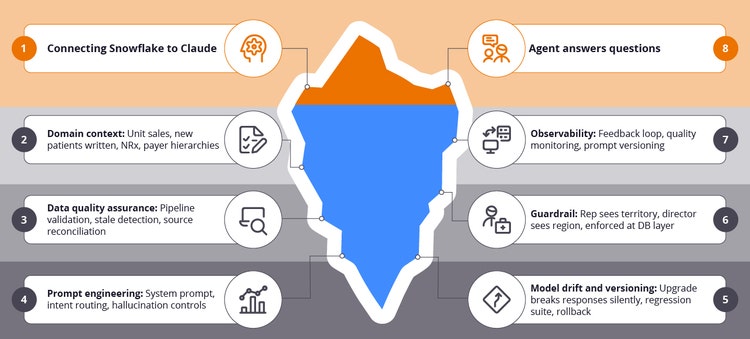
The expensive part of agentic AI is not connecting a model to a data warehouse. It is teaching the agent what the business means, what it is allowed to do, how it should behave when confidence is low and who is accountable when the answer changes.
Those costs do not appear in the demo. They appear in the operating model: domain translation, data readiness, compliance review, prompt versioning, regression testing, model drift monitoring, user support and incident response.
Why horizontal AI platforms need pharma-specific context
Claude is an extraordinary reasoning engine. Snowflake is a world-class data infrastructure. Microsoft Copilot is a genuinely capable productivity layer. But these tools are horizontal platforms, while commercial pharma is vertical.
Can any of these tools, out of the box, understand the edge cases in prior authorization approval rate calculations, why a 3% variance is noise in one context and a compliance flag in another, or how incentive logic changes across brands, roles and markets?
These gaps are not prompting gaps. They are knowledge architecture gaps.
Closing the semantic gap—turning natural language into a validated query—is real progress. But closing the semantic gap is not the same as closing the agent gap. The agent gap is where the real complexity lives:
- Answering versus sensing: Query-based AI answers questions users ask. Agents monitor commercial signals continuously and surface issues before anyone thinks to ask.
- Querying versus reasoning: Translating natural language into a query retrieves data. Decomposing a TRx gap into engagement, access, competitive and unexplained drivers requires multistep commercial reasoning.
- Connecting versus governing: Connecting to data is only the start. Protected health information (PHI) controls, off-label classification, row-level security and audit trails have to be designed into the architecture.
- Deploying versus operating: Shipping an agent is not the finish line. Prompt versioning, regression testing, model drift detection and observability are ongoing production disciplines.
Getting Claude to produce a reasonable incentive compensation summary in a sandbox may take an afternoon. Getting any agent to do it reliably across thousands of users, with role-based access, calculation traceability, prompt versioning, model upgrade governance and human review thresholds, is a production software problem. That is the difference between a demo and an operating capability.
None of this means pharma companies should avoid agentic AI. It means they need to account for the full cost of making agents safe, useful and durable—not just the visible cost of the operating layer.
Why agentic AI risk becomes operational risk in pharma
The same operating layer that drives cost also determines risk, which is why AI governance in pharma can’t be treated as a post-launch control. Once an AI agent can trigger workflows, route recommendations or influence decisions, the issue is no longer whether the answer is accurate in isolation. The risk is what that answer causes next.
- Business risk: Acting on flawed territory, account or incentive logic.
- Compliance risk: Exposing the wrong data, surfacing unapproved content or losing the audit trail.
- Trust risk: Teaching the field that the system cannot be relied on.
For example, in pharma commercial, “relabeled” is not a rounding error. It’s a compliance surface, a rep-facing tool that erodes trust the first time it’s wrong and an engineering bill that shows up eighteen months after the demo, not eighteen days.
Reputation and legal exposure compound that cost, and they don’t wait for a root-cause analysis. A generic agent that misreads a payer hierarchy or miscalculates incentive payout doesn’t just produce a wrong number—it produces a wrong number that thousands of reps have already acted on, in front of managers who now have to explain it.
An agent with no MLR grounding that free-associates language about off-label use isn’t a bug ticket; it’s a regulatory filing waiting to happen. An audit trail gap discovered mid-inspection isn’t a data hygiene issue; it’s an exposure the compliance team inherits without ever having chosen it.
None of these are edge cases in agentic AI—they are the default outcome of connecting a capable model to a data layer and skipping the layer that was supposed to catch them.
What purpose-built pharma AI agents need to work safely
The point is not that pharma companies should avoid horizontal AI platforms. But that those platforms need a pharma-specific operating layer before they can be trusted with regulated workflows.
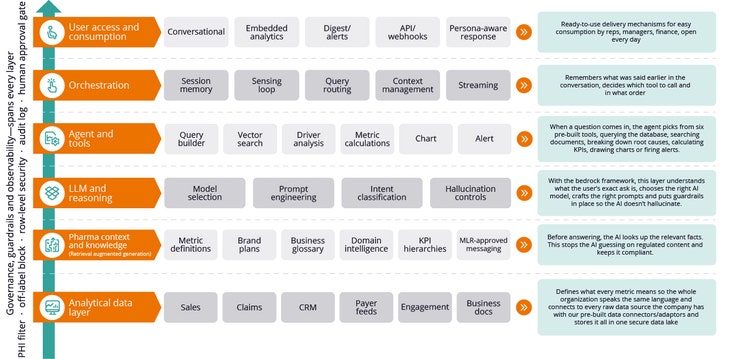
A purpose-built pharma agent is not defined by the model it uses. It is defined by the layers that make ownership possible:
- A governed data foundation establishes what the agent can trust.
- A pharma semantic layer establishes what the business means.
- A compliant knowledge layer establishes what the agent is allowed to say.
- An orchestration layer establishes what the agent is allowed to do.
- An audit and monitoring layer establishes who can explain and improve it.
FIGURE 2: Purpose-built SaaS solutions offer modular architecture with the flexibility to configure and scale with evolving business needs.
The fifth question for pharma AI build-versus-buy decisions
Our CPO posed four questions for leaders evaluating whether to build or buy enterprise software: Can you replicate the domain knowledge, manage the operational complexity, absorb the compliance liability and keep pace with the frontier. Those questions still hold and apply with even more force to agentic AI.
But buying the platform doesn’t retire those questions—it relocates them to a fifth:
Who owns the agent after it goes live—and can they govern it safely, cost-effectively and compliantly?
This is not a procurement question. It is an operating model question—and a test of AI governance in pharma. It means naming who reviews a prompt before it ships, who is accountable when an agent’s output drifts and who sits in the room across data science, compliance, commercial ops and IT every time the system changes. Platforms that have already built this operating muscle—across hundreds of deployments, not one—are the ones positioned to answer it convincingly. Most pharma commercial organizations are not equipped to build that muscle from scratch, not because they lack capability, but because running production-grade agentic systems safely is not their core business.
Should pharma companies own the hidden work behind AI agents?
The question for pharma leaders is not whether their teams can assemble the visible parts of an agentic AI system. Many can.
The harder question is whether they want to own everything beneath it: the domain logic, guardrails, governance, monitoring, escalation paths and accountability model that make the agent safe to use.
Purpose-built agents, such as the agentic AI framework in the ZAIDYN® life sciences intelligence platform, help pharma better approach these decisions. They are the prerequisite for deploying AI into workflows where the cost of being wrong is measured in business disruption, compliance exposure and lost trust.
Before an agent goes live, the answer has to be clear: Who owns it, who reviews it, who improves it and who is accountable when it is wrong?
Related resources