What the EU AI Act signals about the future of trusted AI in life sciences
Key takeaways:
- The EU AI Act makes AI transparency a compliance requirement for organizations whose systems are used in or affect the EU—not just companies based in Europe.
- Trustworthy AI and trusted AI are not the same: measurable system performance shows whether AI behaves reliably, but user confidence determines whether people will act on its outputs.
- Life sciences leaders should evaluate AI through both system-level evidence and user-trust signals, including competence, agency, reliability, explainability and benevolence.
Trust is now the baseline for doing business, and it no longer can be assumed from good intentions alone
For life sciences organizations evaluating AI, the question is no longer simply whether a system works. It’s whether people understand it, trust it appropriately and feel confident enough to act on what it produces.
That distinction matters more now. As of Aug. 2, 2026, the EU AI Act is fully enforceable, requiring organizations to be more transparent to users about when and how AI is involved. The regulation is not limited to European companies; it applies to organizations whose AI systems are used in or have an effect within the EU.
By making it clear when people are interacting with AI or exposed to AI-generated content, organizations can begin to create the transparency users need to make informed decisions and trust AI enough to rely on it responsibly.
For organizations building or deploying AI in high-stakes life sciences workflows, this is now more than a regulatory requirement. It raises the standard for how AI systems earn user confidence.
AI has to be transparent enough to comply with the new legislation. But to be trusted, it also has to feel clear, reliable and useful enough for people to act.
What’s the difference between trustworthy AI and trusted AI?
In agentic AI, trustworthiness and trust are related—but they aren’t the same thing.
Trustworthiness is a property of the system. It reflects whether an agent behaves reliably, safely and ethically—and whether teams can verify that behavior through measurable standards for accuracy, completeness, oversight and compliance.
Trust is different. Trust is the judgment a person forms about whether an agent will behave as expected in their specific situation, in their role and at that moment. It’s shaped by how the agent communicates, how it handles uncertainty, how it explains its reasoning and whether it matches the user’s mental model of the task.
Trustworthiness is necessary, but it is not sufficient for creating a trusted solution.
That gap is where adoption breaks down. A commercial analytics agent may produce a high-quality recommendation, but if a field leader does not understand the reasoning or feels the data is stale, they may rebuild the output manually.
A medical affairs workflow may surface the right insight, but if the user can’t see why it was prioritized, they may hesitate to use it with a key opinion leader or internal decision-maker.
That’s why interaction is not adoption. Acting on outputs is adoption.
How the EU AI Act connects AI transparency to user confidence
The EU AI Act puts regulatory weight behind trust and informed choice.
By categorizing AI systems by risk and setting transparency obligations for certain uses, the regulation reinforces the need for organizations to make AI’s role, limits and outputs clearer to users.
For life sciences organizations, this matters because AI is increasingly embedded in workflows that influence high-value, highly regulated decisions: identifying patient journey signals, prioritizing field action, informing commercial strategy, supporting medical engagement and helping teams navigate complex data.
In these environments, transparency can’t be reduced to a single disclosure label. Users need enough context to understand what the AI is doing, where its limits are and how much confidence to place in the result.
That context is what separates disclosure from confidence. Compliance asks: Did we tell the user AI is involved? Trusted adoption asks: Did we help the user decide whether, when and how to rely on it?
How life sciences organizations can measure whether users trust AI
The next step for AI leaders is to measure trust as deliberately as they measure performance.
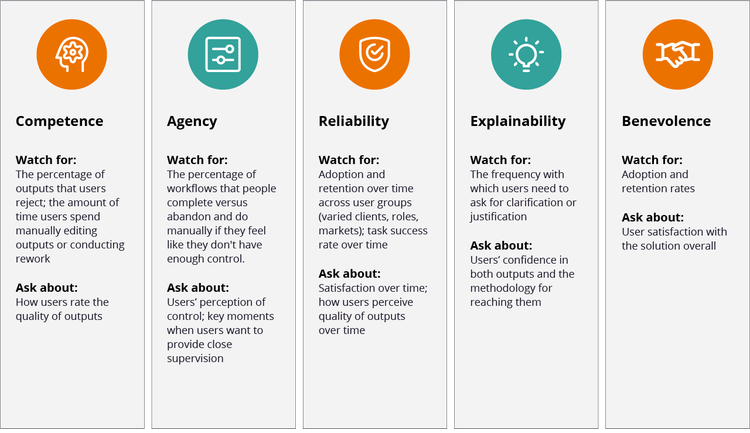
Rather than treating adoption as a usage metric alone, organizations should evaluate how well users see an AI agent as capable, understandable, reliable and appropriately within their control—and whether those perceptions translate into confident action.
For life sciences leaders, this kind of measurement can help reveal where trust is forming, where hesitation remains and what needs to improve before AI can scale responsibly.
The goal is calibrated trust: users understand the agent well enough to rely on it appropriately.
As a best practice, life sciences leaders should look for both behavioral and attitudinal evidence before scaling AI.
Behavioral signals may include rejected outputs, manual rework, abandoned workflows and repeated clarification requests. Attitudinal signals can come from asking users whether outputs feel credible, whether they understand the reasoning and whether they feel in control.
Together, these signals can be used in a framework to measure whether an AI capability is ready for users to rely on—not just interact with.
FIGURE: 5 elements that underlay user trust in agentic AI
Why trusted AI solutions are becoming a commercial differentiator
As life sciences companies evaluate AI partners, many are already asking for proof that agentic systems behave reliably, transparently and within appropriate boundaries. The EU AI Act reinforces those expectations, but the market is moving in the same direction: buyers want evidence, not assurances.
A repeatable trust measurement standard can become part of that evidence. It can help product teams identify trust gaps before deployment, guide investment toward the dimensions that matter most and create a credible benchmark over time.
For enterprise buyers—especially CIOs, commercial leaders, medical affairs leaders and compliance stakeholders—this kind of measure answers a practical question: How do we know users will trust this agent enough to use it responsibly?
The answer cannot come from technical validation alone. It has to combine system-level rigor with human-centered insight.
How ZAIDYN aligns with EU AI Act transparency expectations
The EU AI Act did not create the need for trusted AI experiences. It made that need more explicit.
ZAIDYN has been designing and building for transparency and trust in AI before the Act’s transparency obligations became enforceable: making its AI involvement clear, communicating what its AI is doing, reinforcing appropriate confidence and giving users the context they need to make informed decisions.
That work is supported by QA and validation that test system behavior, governance and security that define guardrails, and user experience design and research that creates and tests whether trust is forming in the people who use the product.
Together, they help ensure ZAIDYN solutions are not only built to be trustworthy by design, but trusted in practice.
For life sciences organizations, that’s the real test of AI readiness. The future will belong to teams that can show their AI systems are compliant, transparent and verifiable—and that users trust them enough to act.
Related resources



See ZAIDYN in action
