When AI decorates the dashboard
Key takeaways
- AI features layered onto dashboards can summarize or retrieve data faster, but they don’t close the gap between what happened and why it happened.
- Commercial pharma teams need AI systems built on governed semantics, domain-aware reasoning and deterministic response structures—not just chat interfaces.
- LLMs are most valuable as the last-mile generation layer, translating trusted architecture and evidence into clear, defensible narratives for decision-makers.
Why pharma still can’t answer the questions that matter
Every enterprise business intelligence (BI) tool now ships with AI. There’s a summary under every chart, a chat box on every dashboard and an “ask your data” button on every landing page. And yet if you sit with a commercial pharma analytics team, you’ll hear the same thing you heard three years ago: the ad hoc request queue is still full. The answers still take days and the decisions that matter are still being made in the gap between what the dashboard shows and what the business needs to know.
The reason is simpler than the tooling suggests. Most of what gets marketed as AI in BI today is AI decorating BI. A dashboard with an autogenerated caption is still a dashboard. A chat interface that returns a chart is still, structurally, a lookup. Neither closes the gap that HQ commercial teams actually feel every day—the gap between what happened and why it happened.
That gap isn’t a UX problem. It’s a context-and-architecture problem. And it’s the one worth naming clearly before we talk about what to build next.
What commercial analytics teams ask that dashboards can’t answer
Spend a week shadowing a brand director or a commercial analytics lead at emerging or growth pharma companies, and the pattern is unmistakable. They don’t ask “show me units by region.” They ask:
- Why is uptake in the West lagging in the Q3 forecast?
- Which HCP segments are driving the flat trend in new patient starts?
- Is the dip in Boston territory a rep coverage issue or an access issue?
These are diagnostic questions. Causal questions. Questions that require decomposing a metric, testing hypotheses against domain knowledge and returning a defensible narrative, not another chart.
The tools were built for retrieval. The questions are about reasoning. That’s the mismatch, and it doesn’t get fixed by adding a chat interface on top.
Why AI dashboards fall short on reasoning
In pharma commercial intelligence, the current generation of AI-in-BI features falls into three camps, and each has the same structural ceiling.
Auto-narration: A summary generated over a chart. This doesn’t reason; it narrates. The chart already told you sales are down 8%. The AI-generated caption tells you sales are down 8%, in a full sentence. Nothing new has entered the conversation.
Natural-language-to-SQL: You type a question; the system translates it to a query; the query returns a table or a chart. This is faster search. It’s genuinely useful for a slice of tier-one analytical questions—the what questions. But the moment you ask why, the model has nothing to ground its answer in. It generates plausible-sounding text against retrieved rows, and the confident tone masks that no actual diagnosis has occurred.
Multiturn conversational analytics: The current frontier for most platforms. In principle, this could carry state across a diagnostic chain: sales are down, drill into region, drill into customer segment, isolate the driver. In practice, it breaks down predictably. Metric binding fails—ask about “sales,” and the system silently switches from total prescriptions to new prescriptions by the third turn. Time context breaks—“last eight months” gets interpreted as “last year.” Cross-channel grounding fails—the system asserts a causal relationship between rep activity and prescription volume without any structural knowledge of whether that relationship holds in this therapeutic area, at this launch stage, in this access environment.
Closing this gap requires three structural moves, and each depends on the others to work.
FIGURE: 3 architecture changes commercial analytics AI needs to answer ‘why’
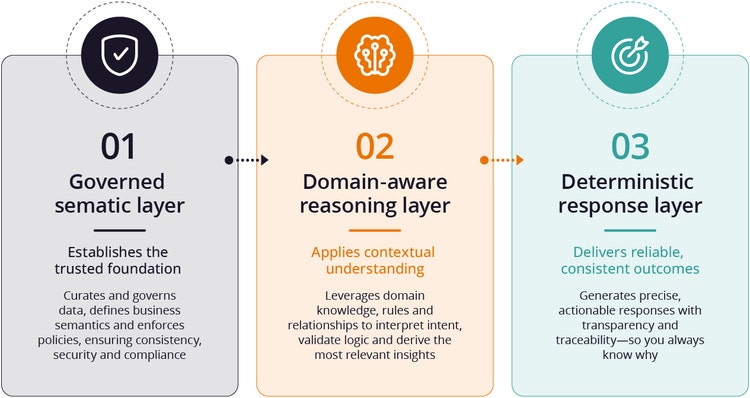
The first is a governed semantic layer that isn’t inferred. Metrics, comparison anchors, drill-down grammar, threshold logic—all of it curated, versioned and authored by people who understand the business. Not extracted from a schema at query time. This is the part the industry has started to agree on, and it isn’t a pharma-specific failure. McKinsey’s 2026 State of Organizations research found that while 88% of organizations are deploying AI, 81% report no meaningful bottom-line impact—a gap McKinsey attributes not to the technology, but to how it’s embedded in the organizations using it.
The second is a domain-aware reasoning layer. This is the part almost no platform has cracked, and it’s the one that matters most for pharma commercial intelligence. A general-purpose LLM asked “why did new patient starts flatten in Q3” will produce a fluent hypothesis. But it doesn’t know that in an oncology launch, the leading indicator is HCP awareness three months prior, or that in a specialty launch, payer coverage transitions lag policy announcements by roughly six weeks. Those relationships aren’t in the data. They sit with the people who have taken multiple emerging pharma launches to market and guided companies through the growth transition—experts who have seen these patterns repeat across therapeutic areas, launch stages and access environments.
A system that reasons against pharma commercial performance needs those relationships encoded as first-class objects—a causal graph the model traverses, not a set of vibes the model improvises.
There’s an economic consequence too: the more domain structure the system carries, the less it depends on brute-force model horsepower—which is the difference between AI economics that scale with usage and AI economics that spiral with it.
The third is a deterministic response structure. Layout, evidence order, what fires and when—all of it governed by contracts, not left to the model. The LLM does last-mile content generation. Everything else is decided by architecture. That’s the difference between an analytics product you can trust in an executive review and one you can’t.
When all three are in place, the “why” question becomes answerable rather than aspirational. Remove any one of them, and the outcome reverts to a familiar pattern: another dashboard with a conversational interface layered on top.
How ZAIDYN® turns commercial analytics AI into explainable ‘why’ answers
This isn’t a hypothetical architecture. It’s the approach we’ve built into ZAIDYN’s commercial intelligence layer and the shape of the next generation of conversational analytics we’re bringing to commercial teams.
The semantic layer underneath ZAIDYN is authored, not inferred—metrics, comparison anchors and drill-down grammar curated with pharma commercial SMEs, configured per client, versioned as an asset. On top of that sits a domain-aware reasoning layer that encodes the leading and lagging indicator relationships pharma commercial teams already reason with—made available to the system rather than left for it to guess. And every response comes out of a deterministic contract, with the language model doing content generation.
The next five years won’t be won by commercial pharma analytics teams with the most AI. They’ll be won by teams whose AI can answer the question a dashboard never could, and can defend the answer when a brand leader pushes back on it.
Platforms that decorate are converging. Platforms that reason are the ones worth choosing.
Related resources



See ZAIDYN in action
