How agentic AI is transforming incentive compensation design and operations
Designing a human-in-the-loop operating model for autonomous IC
Key takeaways
- Incentive compensation (IC) remains one of the most powerful levers in pharma commercial operations to motivate field forces and drive effective execution of commercial strategy—yet the process that governs it is often manual, reactive and operationally heavy.
- Agentic AI in IC represents a structural shift from rules-based automation to AI-led, human-governed decision systems that can sense, decide, act and learn from outcomes under clear guardrails and human oversight.
- Agentification alone does not deliver autonomy. It delivers faster manual processes with an AI label. Closing the gap requires operating model redesign, evidence-based adoption and a talent strategy purpose-built to govern agents—not just deploy them.
- Organizations that embrace autonomy can expect to reduce IC operating costs by 30%-50%, cut reporting cycle times by 50%-60%, and redirect more than 40% of IC team capacity toward strategic performance optimization, according to ZS data.
The structural gap in IC design and operations
Picture a driver in a self-driving car. The car maintains speed, stays in the lanes and brakes automatically—without the driver touching the wheel. The driver still governs setting the destination and monitoring the journey, taking control when real judgment is required. Technology handles what is deterministic. The human handles what is not.
IC design and operations have not made this shift. Most operations still depend on manual reconciliation, exception spreadsheets and reporting cycles that take weeks to produce what should take hours. Plans are designed in isolation from live commercial data. Exceptions sit in queues waiting for an IC analyst with capacity to investigate. Reps who question their payout wait days for a response an agentic system could deliver in minutes. And whatever is learned in one cycle lives with whoever ran it, and leaves with them when they move on. Automation helped at the margins. It did not transform how IC operates.
What agentic AI changes in IC, and what it doesn’t
Agentic AI in IC does not improve IC at the margin. It changes how IC operates across three fundamental shifts:
- From periodic to continuous: The system senses and acts between cycles, not just at cycle close. Anomalies surface before they become disputes. Plan health is monitored regularly, not assembled retrospectively for a period-end review.
- From reports to decisions: Outputs include recommendations with trade-offs modeled, escalation paths defined and decision rights clear. The IC analyst receives a prepared case, not a raw data pull.
- From individual expertise to institutional intelligence: The knowledge that currently walks out when an IC analyst changes roles—which anomaly patterns matter and which plan interpretations have been settled—becomes part of a knowledge base that compounds with every cycle it runs.
What does not change is equally important. Agentic AI does not replace the domain expertise needed to govern its outputs, the data quality required for its reasoning to be sound or the human accountability for the commercial intent behind every plan. The IC analyst does not disappear; their role shifts from executing process to governing intelligence.
Autonomy is a spectrum, not a switch. Not every IC decision should be automated at the same rate—payout calculations can run zero-touch from cycle one, while plan design and institutional decisions should move toward autonomy only as the system earns that trust through demonstrated reliability.
FIGURE 1: The four-stage calibration model
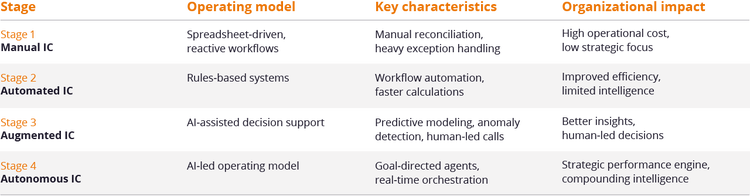
Most IC operations sit at Stage 1 or Stage 2 today. The realistic near-term target is Stage 3—augmented IC—where agents assist decisions that humans still govern. Stage 4 is the horizon, not the starting point. Each stage must be earned before the next is attempted. Skipping that progression is how consequential IC decisions and payouts go wrong.
Introducing the IC decision flywheel
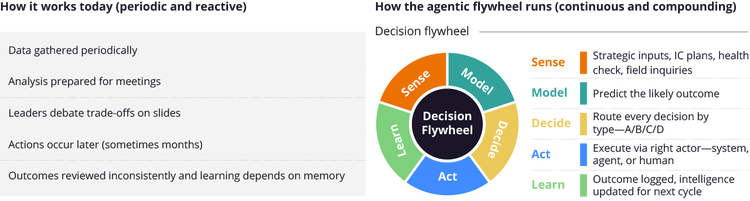
At the center of autonomous IC is the decision flywheel—the cycle every IC operation already runs: data in, analysis, decision, action, outcome and learning. The question is not whether the cycle exists but whether it is spinning. In most IC operations today, it barely moves. Data arrives stale. Analysis is assembled for fixed-schedule meetings. Decisions are debated but the reasoning rarely survives the people present. Learning is never formally captured.
Consider a rep who messages IC: “My Q3 payout is lower despite higher sales—something is wrong.” Today that sits in a queue for days while an IC analyst manually checks quota records, territory data and plan mechanics. An agentic IC system investigates in minutes, explains the root cause in plain language with a full audit trail, and logs the resolution as a precedent—so the next similar inquiry is faster still.
That is what a spinning flywheel delivers: detection speed, structured reasoning and auditability, not a faster version of the manual process but a fundamentally different one.
FIGURE 2: The differences an agentic AI spinning flywheel creates
How humans and AI partner in IC
Autonomous IC does not mean removing humans from IC; it means redefining where human judgment, accountability and governance sit in the system. A plan that governs how thousands of sales professionals earn their living should not run without clear human oversight. What changes is where in the system humans engage and what they are asked to do.
Building toward autonomous IC: what the foundation requires
Most IC operations today are rules-based and reactive—faster than they were a decade ago, but not fundamentally more intelligent. Moving from there to AI-assisted decision support, and ultimately to fully autonomous operations, requires four things working together. Each is necessary. None is sufficient alone.
Decision architecture—IC operations redesigned around the sense-model-decide-act-learn cycle, with every decision classified by type and routed to the right actor before any agent is deployed. Without this, agents produce faster outputs that still go to the wrong place. The system does not improve between cycles.
Agentic capabilities—Goal-driven agents spanning plan design, configuration, execution, monitoring and inquiry management are a coherent capability layer across the full IC life cycle, not point solutions on individual tasks. A point solution produces a faster output. A coherent layer accumulates intelligence: every resolved inquiry and confirmed anomaly becomes a precedent the system reasons from next time.
Operating model redesign—Decision rights governed, workflows rebuilt around exceptions rather than manual processing, and an adoption approach that builds trust through evidence before asking IC teams to hand over decisions they have always owned. Technology deployed on an unchanged operating model produces one outcome: a faster version of the same broken process.
Talent reconstitution—IC teams rebuilt (not retrained) around judgment, oversight and intelligence stewardship. New roles emerge: AI product manager, agent operations lead, IC knowledge steward, AI governance lead. The knowledge steward role is particularly critical; it’s responsible for curating the precedent library, validating what the system has learned and ensuring the institutional intelligence that compounds across cycles is accurate and governed.
Organizations that build all four simultaneously accumulate a compounding advantage. Those that build only agentification build a faster version of what they already have.
From IC principles to agentic AI practice
The driver in the self-driving car is not less capable than the one who steers manually. They are differently capable—governing the journey rather than executing it. Done well, it frees analysts from work that does not require them, so the work that does, gets done better. Done badly, it adds opacity and scales errors faster.
The potential of autonomous IC is real, and the shift is worth making. What determines the outcome is not just the technology, it is the architecture beneath it: decision-routing designed with intention, auditability built in from the start and learning loops that compound with every cycle.
Related resources



See ZAIDYN in action
