3 ways life sciences can scale agentic AI across the enterprise
Key takeaways
- Scaling agentic AI starts with agents grounded in a life sciences ontology that understands life sciences data, workflows, terminology and regulatory boundaries.
- Scale depends on coordinating decisions across teams, including how competing signals are resolved into a single plan that a human expert reviews before anything gets executed.
- Governance, auditability and human control are essential for scaling agentic AI safely in a regulated life sciences environment, and they are what make cross-functional coordination possible without blurring the line between medical and commercial work.
Many life sciences companies are piloting agents, but fewer have reached the point where those agents change how decisions are made.
Commercial, medical, patient and content teams are no longer simply asking whether agents can summarize information, answer a prompt or automate a step in a workflow. They’re asking whether agentic AI can help their organization act faster, coordinate across functions and make better decisions as launches grow more complex, access tightens and each customer interaction carries more weight.
The answer depends largely on how they approach scaling.
Adding more agents is not the same as scaling agentic AI. Putting agents on top of disconnected data, fragmented workflows and inconsistent terminology can reinforce the silos companies are trying to reduce.
To scale agentic AI in a regulated, high-stakes environment, life sciences organizations need agents grounded in life sciences ontology and context, so they can create a shared understanding of the customer, then act with governance, cross-functional reasoning and continuous learning.
In our conversations with commercial and medical leaders, the recurring concern was not whether agents can complete tasks. It was what happens when agents disagree: when an access signal argues for shifting effort to one segment, a brand priority argues for holding the current plan and a medical insight points to a different message altogether.
In large part, scaling agentic AI is a decision coordination problem. Agents need to understand the data, language, rules and workflows of life sciences, and they also need a way to reconcile competing signals into one plan that experts can review, approve and learn from.
Life sciences organizations can do this in three ways.
1. Ground agents in a shared life sciences ontology
Many AI programs begin with individual use cases that are built for horizontal functions: a field planning agent, a content agent or an analytics agent. That can prove value quickly, but it does not guarantee enterprise scale. If each agent interprets the business differently, teams must reconcile conflicting definitions of the same customer, product, account or opportunity before they can take timely action.
Life sciences companies need agents that are grounded in the domain from the beginning. That means they understand life sciences data, commercial and medical workflows, customer engagement patterns, regulatory boundaries and the specific terminology teams use every day.
This depth of domain context is not built into most general-purpose agents; ZAIDYN is built to bring it forward by drawing on ZS’s decades of consulting experience across life sciences strategy, operations and technology. A life sciences ontology gives agents a common structure for interpreting that information, so teams are not each working from a different meaning of the same signal.
This foundation matters because scaling agentic AI is not only a technology problem. It is a shared-understanding problem. When agents act from consistent definitions and domain context, their recommendations are more credible to the experts who use them.
Field teams can trust that call priorities reflect current access and opportunity. Medical teams can see how care gaps are identified. Content teams can trace claims and references through governed workflows. IT and compliance leaders can evaluate how intelligence is being applied and controlled.
Without this foundation, scale is harder to sustain. With it, each agent works from the same life sciences context and can support a broader operating model from the start.
2. Turn cross-functional signals into one coordinated plan
Once agents understand the domain and context, the next way to scale is to share their intelligence across the enterprise.
Because most current AI programs mirror a siloed life sciences operating model, each function has its own data, workflows, systems and signals, leaving teams with only a partial picture of the customer.
The opportunity is to connect those signals across functions so teams can create a more complete, current picture of the customer, one that supports coordinated decisions and actions. Scaling agentic AI requires those signals to inform one another while each function stays within its role and rules. That is what separates isolated automation from cross-functional reasoning: agents help coordinate the decisions and actions required for the outcome.
When agents work from one shared, continuously updated understanding of the customer, an insight surfaced in one function can shape the next action in another.
Coordination also means deciding what happens when signals conflict. An access change may argue for shifting effort toward one segment while brand priorities argue for holding the current plan. Rather than letting each agent act on its own conclusion, a scalable approach resolves those signals into a single proposed plan, shows the trade-offs it weighed and lets the accountable expert choose before anything executes.
FIGURE: A scalable AI approach for a brand team responding to a payer moving its product to a preferred formulary tier
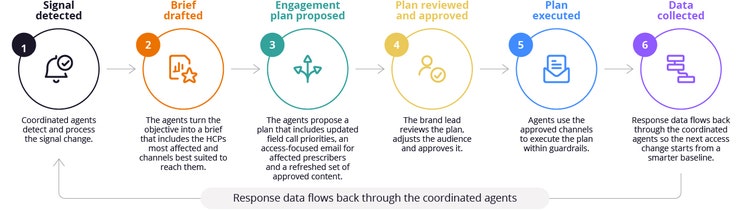
Each function contributes what the outcome needs, and no one has to reconcile three separate recommendations by hand.
A more difficult version of this problem sits at the boundary between medical and commercial. Insights generated through scientific exchange can create value beyond medical, but how those insights are shared and used needs to preserve the independence and nonpromotional role of medical.
Rather than avoiding this boundary, a scalable approach makes the guardrails explicit: Medical insights can inform broader organizational strategy through appropriate aggregation, governance and defined cross-functional handoffs, while individual HCP-level interactions and scientific exchange remain within medical. Building these boundaries into the workflows, data and systems themselves, rather than relying on policy alone, makes cross-functional decision-making more credible and scalable in a regulated environment.
The value is that agents can coordinate across teams, using only the functions the outcome requires, so decisions happen on agreed ground.
For leaders, this changes the scaling question. Instead of asking how many agents the organization can deploy, life sciences leaders should ask whether those agents can carry context across functions, resolve conflicting signals, explain their reasoning and respond while it is still relevant.
3. Govern agentic AI so it can adapt safely over time
Agentic AI cannot scale in life sciences if teams do not trust it. That means agents must show what they are doing, why they are recommending it and indicate where a human expert needs to make the judgment call.
Governance has to be built into the architecture, not added after deployment. In a highly regulated life sciences environment, recommendations need to be explainable and auditable, actions need to run inside defined permissions and guardrails, and promotional and scientific work must remain separated at the data, access and agent levels. In practice, that means human experts review and approve the plan as a whole, across channels and functions, before execution rather than auditing individual actions after the fact.
Strong governance also helps agentic AI adapt.
Models will change. Systems of record will evolve. New brands, markets and regulations will add complexity. A scalable approach cannot be tied to one model, one CRM or one fixed workflow. It needs to sit above existing systems, connect to the data where it already lives and keep the shared understanding current as the business changes.
This is an important consideration. Many agentic offerings in life sciences extend a single system of record, which means their intelligence is bounded by what that system can see. Companies evaluating agentic AI should ask whether the intelligence layer will keep working, and keep its context, if their CRM, content platform or model provider changes.
That is why change management matters as much as implementation. Life sciences companies do not unlock value from agentic AI simply by installing agents. They unlock value when teams adopt new ways of working, understand when to trust recommendations, know when to intervene and see how every action feeds a smarter operating model.
With ZAIDYN, ZS teams support that change alongside the technology. Over time, the outcome of every approved plan, including what the expert changed and how customers responded, should feed back into the shared playbook so each brand and market starts from a smarter baseline instead of starting over.
Scaling agentic AI starts with shared intelligence
As agentic AI becomes more common, life sciences leaders need a sharper evaluation lens. Five questions can help separate agents that automate tasks from agents that can scale:
- When two agents reach conflicting recommendations, how is the conflict resolved, and who decides?
- Can the accountable expert see and approve the full plan before anything executes?
- How does the system keep medical and commercial work separate, and can compliance audit every handoff?
- Will the intelligence layer keep working if our CRM, content platform or model provider changes?
- How do expert edits and customer responses feed back into future recommendations?
The next phase of agentic AI in life sciences will depend less on adding more agents to fragmented systems and more on building shared intelligence that every function can trust and act on. That starts with agents grounded in a life sciences ontology. It scales through coordinated decisions across functions, and it is sustained when governance, human control and continuous learning are built in from the beginning.
For emerging life sciences companies, that can mean launching faster with the coordination of a larger organization without building silos into the operating model. For global life sciences companies, it can mean scaling consistent decisions across brands, markets and geographies while preserving local flexibility and compliance.
That is the direction ZAIDYN is building toward: a shared intelligence layer designed for the data, rules and decisions of life sciences, which over time is designed to connect commercial, medical, patient and content workflows so teams can apply grounded agents, coordinated decisions and governed adaptation where launch decisions are made.
When life sciences companies get these three areas right, agentic AI can do more than automate tasks. It can help close the gap between signal and coordinated action, enabling teams to work together, respond in a timely way and improve with each launch.
Related resources



See ZAIDYN in action
